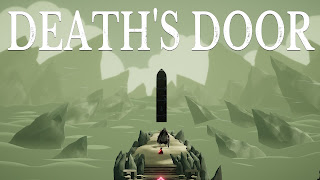
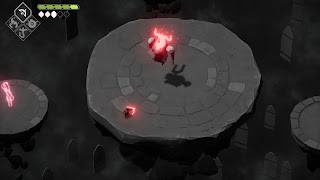
This is an Action Adventure game that I've been playing between Christmas and New Year. This came out the same time as Skyward Sword HD last year and can be best described as a "Zelda-like" with a more challenging difficulty. But since this blog is all about Zelda (and Metroid), it's interesting to take a look at other Action Adventures or Action RPGs from time to time, where this one is truly a gem.
The game really shines with its otherworldly experience, where everything has its own unique charm to it. The team behind Death's Door, Acid Nerve, is very small with only two developers and a couple of artists, which makes this game appear even more impressive, but also led to the kind of simplicity that early video games had – in visuals, gameplay, and character designs. So, let's take a look.
Story
In Death's Door you're playing as a "Reaper", a silent protagonist crow that is hunting souls for the Reaping Commission Headquarters, some kind of office for the afterlife, where time stands still. Those souls you're after don't want to go to the afterlife willingly and therefore need a little push. But an older Reaper steals your assigned soul and brings it to "Death's Door", where it wants to open it. You learn that a lot of shady things are going on with your organization, especially with its leader – the Lord of Doors. And the old crow asks you to bring three giant souls, who all have lived long beyond their time and grown corrupted, in order to open Death's Door.
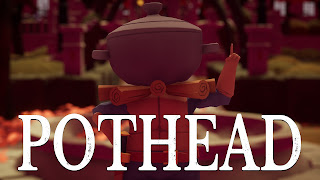
The story plays with the topic of death in a very unconventional way and has its moments, but in typical Zelda-fashion it's mostly an excuse to have you hunt for a number of things all over the world. What's really memorable are certainly its characters, who are all quite charming and unique. You don't get many persons with actual faces for example, instead you will meet curious guys like "Pothead", who has a pot for his head. It's super silly at first, but there is a serious story as to why he ended up like that, which also goes hand in hand with the general theme of the area, where you first meet the guy.

It's also of note how most of the bosses in the game are actual characters, which you usually meet a couple of times before you truly fight them for some memorable moments. They all have understandable motives, after all they just don't want to die, but these interactions let them appear a lot more special and as a real part of the game world, while it also creates a nice build-up for their fights.
And in all that the game really understands to play with you on an emotional level, despite the quirkiness. It's no Shakespeare, it's not some extensive fantasy RPG with lots of dialogue, it's short and simple, has quite some black humor, but can still move you for a bit. Something on the lines of Link's Awakening would be a good comparison, just more gritty.
Death's Door is actually the sequel to Acid Nerve's first game, Titan Souls, which is 2D pixel art boss rush game, where you only have one arrow as a weapon and one life. These two games are quite different from each other and Death's Door really stands on its own, so you don't necessarily have to play Titan Souls to understand things. Fans of the original title will be able to appreciate some of the references, however.
Presentation
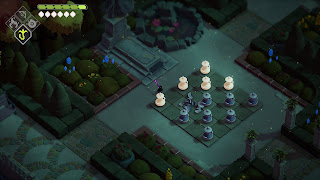
Death's Door is using an isometric view most of the time, which makes it stand out for this type of game and is also good for some unique puzzles, where it uses the perspective to hide things in the environment. The camera then usually shifts around to reveal these things, once you get close to them, where sometimes it feels a little bit like Captain Toad: Treasure Tracker with a fixed camera, especially since you can't jump in either game.
But the cel-shaded visuals are really pretty and often surprisingly detailed, where this already gives the game the sort of timeless appeal that will make it age very well. Maybe even a little bit too well for the liking of the reapers, because it doesn't always run perfectly smooth, where there some noticeable drops in the frame rate every now and then, even on a stronger PC. The Nintendo Switch version also only runs in 30FPS and has considerable less details.
The soundtrack by David Fenn, who is one of the two developers, is absolutely fantastic and really adds tremendously to the charm of the game, which can't be praised enough. A lot of is quite melancholic, but of course this comes with the territory in a game that is all about death. But the melodies are absolutely beautiful, using a variety of instruments and memorable themes, where there is never a dull moment thanks to them. (Since words often fail to describe things, it's probably best to listen to the soundtrack yourself, which you can find on Youtube.)
Controls
With one exception the controls of the game are as simple as it can get for this type of Action Adventure. You have a normal and a strong melee attack, you can roll, you use your items for ranged attacks, and there is a button for interactions, like reading, talking, or using switches, just like in Zelda.
Even though you're playing as a crow, rolling is curiously the only way of going faster and of dodging enemy attacks, where it has some invincibility frames to it. In combat this is absolutely crucial, but for moving around it feels a little bit archaic, where you just keep rolling all the time, like in Ocarina of Time, The Minish Cap, or Four Swords Adventures. It would be great if you could hold the roll button to perform a dash afterwards in order to move around faster, because the movement feels a little bit slow overall, even when you've upgraded your base speed via the "Haste" ability. (Curiously, such a dash is exactly what Acid Nerve had done in the predecessor, Titan Souls, where it's weird that this wasn't carried over.)
Since Death's Door is played in an isometric view and you often go diagonally, you will move around with the analog stick. The D-pad instead is used to switch your magic weapons, where there is one for every direction. This makes it very simple to switch items in the middle of combat, where unlike in most Zelda games you don't have to open a menu to do so. Simple press up to switch to the bow and so on. It feels great, but of course also limits the game to four items in total, where its world and progress was really designed around this fact. You already start with the bow, but you will find the other three items in the three dungeons for the three main bosses.
Aiming with these items doesn't feel as simple as the rest of it, however, where like in Metroid: Samus Returns and Metroid Dread there is a dedicated (shoulder) button for aiming. You can only shoot your magic weapons while aiming and most of them have a charge, so you are holding down the fire button anyway and it would make much more sense if both aiming and shooting were just the same action. The way it is you always have to hold two buttons to shoot, which seems needlessly complicated at first, but also let's you spam weapons while keeping your position and direction.
On the PC you're able to fully remap your controls, but not on the Nintendo Switch version, which seems to be a bad habit of most developers. While you can change your button mappings on the system, this changes it for all games and therefore isn't a permanent solution, even with the presets, so it's generally a good idea to provide such options with every game.
Combat
The combat is really the bread and butter of Death's Door, where this is what sets it mainly apart from your usual Zelda game. Like with Metroid Dread for example, there is a learning curve and some frustration in the beginning, but once you get better, then so does the game. Now, if you're used to combat how it works in Zelda games, then you will have to adapt a bit, because you can't just stunlock enemies by hitting them. Most of them will attack you, no matter what, so you always have to be aware of that and dodge at the right time. If you're greedy with attacking, then you will get punished for it.
Often a good method is to sweep in with a roll attack, where you perform a powerful swing after a roll via the strong attack button, and then dodge away right after. It works quite well for many of the stronger enemies, but overall you will have to find the right strategy for the given situation and enemies.
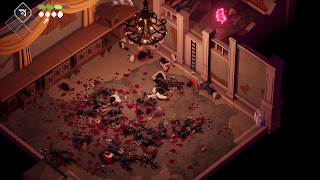
The visuals during combat are somewhat morbid, because enemies will bleed and leave visible parts all over the place, which can create quite a mess. So, that's something that's definitely different from your typical feel-good Action Adventure, but it fits the overall theme of death. It's also often not too bad, where gore and splatter are not a focus of this game, but keep in mind that it can get macabre at times...
What's interesting about Death's Door is how it displays enemy health by giving them visible cracks, often with a red glow. The more cracks they have and the bigger those cracks get, the closer they are to dying. This is such a cool design choice and so much better than displaying giant health meters somewhere on the screen during boss fights.
Apropos, the bosses in this game are all fantastic and well executed with multiple phases, where you have to learn their patterns and try to find the best openings to attack. You can get back into these fights right away after a failed attempt, where it never feels too frustrating. The earlier bosses also aren't too hard, but the later ones will require some learning, before you are able to beat them.
What actually can be even more challenging are the fights against normal foes and mini-bosses, however, where the game loves to pitch you against multiple waves of enemies, similar to Four Swords and Four Swords Adventures. And here the game can be relentless and sometimes also a bit frustrating, because unlike the bosses you will sometimes have to walk all the way back to where you died earlier. There are always shortcuts to open up the environment, so it's rarely ever truly bad, but there can be some lengthier enemy gauntlets and you will hate to fail at the end of them.
Those fights can be so difficult, because it's much harder to pay attention to a
number of foes and all their attacks, where you often have to play very
strategically to survive. Unlike Zelda or Metroid, enemies in Death's Door don't drop any health, only their souls, which don't have any direct advantage in battle. The only way of healing yourself is consuming special flowers that you have planted in pots, where you can find them all over the world. You will need to collect seeds for them and the flowers will only bloom again when you die or leave the area. So, at best, you can heal yourself once in a battle, given that there is such a pot nearby, which is rarely the case.
On top of that you only get four containers of "vitality", your life energy, so you can only tank three hits before you die. You will be able to extend this to six eventually, but the necessary Crystal Shards, which act like Pieces of Heart, are hard to come by and you be stuck with four health for the majority of the game. Death's Door constantly puts you on the same edge as the Hero Modes do in an early Zelda game, where you only have few Heart Containers and maybe no bottles.
But this edge is what can make Death's Door so addicting, especially since the battles are tough, but never unfair. You can always find ways to avoid enemy attacks if you know what you are doing and a very skilled player might be able to get through the game without getting hit at all. You can use enemy fire against them, for example, where one essential mechanic is being able to reflect fireballs with your melee weapon. And the right usage of your weapon arsenal also can play a key role in this...
Weapons
The game has five different melee weapons and four different magic weapons to collect. You start with a sword and bow, where the latter lets you attack enemies from a safe distance, but this costs magic. Like with your vitality, you get four rounds of magic and you can eventually extend this to six.
You can always refill your magic by hitting things that can be affected by your melee weapons. Those are enemies, of course, but also pots, mushrooms, ice, switches, or crates. The latter won't respawn once they are destroyed, but some other elements, like the mushrooms, will after a short time, so you can use them to replenish your magic at any time.
It's a very interesting system, where it limits your defensive play, but always lets you get back to it by playing offensively for a bit. If you're out of magic and there is nothing else around, you will have to attack the enemy to get your arrows back. And this works very well.
Over the course of the game you will find more magic weapons with different abilities, which are all necessary to progress through the game. The fire spell lets you set things on fire, the bomb spell blows stuff up and the Hookshot works mostly how you would expect it from a Zelda game, so you can use to pull yourself over gaps via certain poles.
The Hookshot doesn't use up any magic, however, and can also be used on every enemy to pull yourself towards them. The only time a Zelda game let you do this were the Shadow Link battles in A Link Between Worlds, but here it's one of the best moves, where it lets you slash your foes on arrival. This even can be used to cross over gaps, for example if you need to reach nasty archers attacking you from the other side. This is one of the best Hookshot implementations in a video game and it's a lot of fun to use, where Zelda could learn a thing or two from Death's Door.
This Hookshot slash and all magic weapons can be upgraded by defeating a series of secret bosses, called the Silent Guardians, which take quite some skill to beat them. These upgrades are fully optional, but all very much worth the trouble.
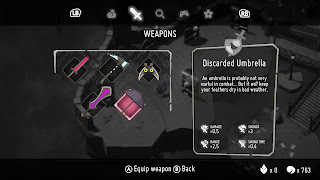
The additional melee weapons are all optional as well, where the three main ones – sword, daggers and hammer – are well balanced in terms of power and speed. There is an overpowered weapon to find later on, however, and you can also use an umbrella as a joke weapon, which only does half as much damage as your normal sword. So, this is a self-imposed challenge, similar to the Cursed Ring in Oracle of Ages & Seasons, but there is an achievement / trophy called "Academy of Umbrellas" for beating the game with only ever using this weapon. (This doesn't apply to the Nintendo Switch version, since there is no achievement system there.)
World and Exploration
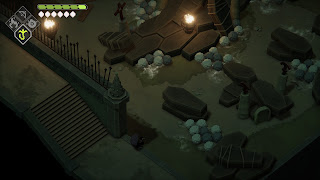
You start in the "Hall of Doors", a timeless void where you get your assignment(s) as a reaper. A first door opens here for your mission to reap a giant soul in the Grove of Spirits, but you will find your way into a forbidden region, the Lost Cemetery, and from there to all the other areas of the game. On your journey you get to unlock new doors, which all lead back to the Hall of Doors. So, this area acts as a hub for portals, where you can quickly switch locations.
The Lost Cemetery on the other hand is your usual central area, like Termina Field in Majora's Mask or the Temple Grounds in Metroid Prime 2: Echoes, so from there you will get access to the other areas of the game, where the dungeons are found. There are three more giant souls waiting for your in three different regions all around the Lost Cemetery: the Estate of the Urn Witch, the Overgrown Ruins and Castle Lockstone.
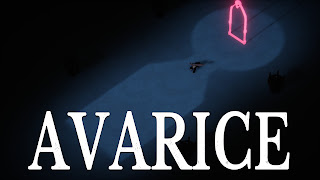
Each area has a dungeon, of course, where in each dungeon your goal is to track four souls of your fallen fellow reapers. This will open a door to an "Avarice" trial, which lets you earn the additional weapons. Those act as your primary way of progression, so you can move on to the other areas with them already. This also means that you can save all the main bosses for later and beat them in any order, like you could in Zelda II - The Adventure of Link. It's even more convenient here.
Unlike in Zelda games, the bosses don't wait at the end of a dungeon, instead you will progress to another area, which acts more like an enemy gauntlet. And only after you've made it through this, you will be able to face the boss. It's quite formulaic, but since there are only three of these parts, it never feels repetitive or stale. It also helps that the main areas feel all very distinct from each other.
The first area for example is entirely themed around pots, which makes it very unique, not only in this game, but overall. There are pots everywhere, living pots as enemies, pot puzzles, and also the aforementioned Pothead character. The Zelda series used to do something similar with its Bottle Grotto dungeon in Link's Awakening, but Death's Door is taking this a step further and really proves Action Adventure games can and should get a little bit more creative with their theming from time to time, instead of going for the typical forest, fire, water, and desert tropes. That the entire game is themed around doors also adds to its uniqueness.

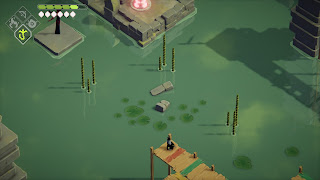
Sadly, the other areas are more on the lines with your typical fantasy cost, where you will have a jungle and swamp setting, as well as your classic frozen fortress in the mountains. This doesn't mean that they are bad, quite the opposite, they all look great and come with a series of mechanics completely unique to them. The swamp for example has switches that can make tiles appear above the water, but those tiles can also be destroyed again.
Puzzles aren't a big deal in Death's Door, however, and are usually just the most basic stuff you would find in a Zelda game: light some torches, pull a lever, or bomb a wall. The focus was clearly on the fights and finding secrets. If a puzzle seems more complicated, it's often because you're still missing some key information, where it's just not possible to solve it yet. But this can also make you waste a lot of time on figuring out some puzzle, where you're still missing a clue or something else.

And the game really doesn't hold your hand in any way, other than giving basic directions, where most of the things you will have to figure out for yourself. It's a game that respects the intelligence of its players, maybe even a little bit too much, because sometimes you might be at loss. For example, Death's Door has a sewer system, which works exactly like in Super Mario Sunshine, where it probably was inspired by that. But you might play through most of the game without figuring this out, because it never really teaches you this and the sewers only lead to some optional goodies, so they can be skipped.
The game also doesn't have a map, by the way, which can add to the confusion. It's only ever an issue in the more complicated main area, the Lost Cemetery, because it can feel somewhat maze-like at first, but once you know your way around it, it's not really a problem any longer. And most of the other areas are simple enough that you don't really need a map for them. Still, a map would have been helpful for orientation, but since the game likes to hide secrets via its isometric view, it probably would have been difficult to make a proper map without giving away too much. But maybe a simple sketch could have worked.
Collectibles
Talking about secrets, Death's Door wouldn't be a real Action Adventure game without a fair share of hidden things. This review has already mentioned some of those, like the optional weapons and weapon upgrades, or the 50 seeds, which are to be planted in 50 pots all over the world. Since these are your only way of healing, they are usually found on the road with the seeds hidden not too badly.
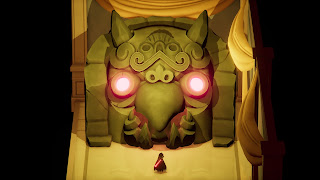
Then there are the 16 Crystal Shards, which you will use to upgrade your vitality and magic meters. They function like the Spirit Orbs in Breath of the Wild or the typical Pieces of Heart, so you will need to collect four of them to complete a container. Curiously, they are all found in these large shrines, but despite this fact they are often cleverly hidden within the environment, where it can be quite impressive how Death's Door manages to play with secrets. The only problem here is that it can take too long to find enough of them to upgrade your health even once, which may make the game appear too difficult on your first run.
Otherwise there are also 24 "shiny things" to collect, which are all individual items with a small story to them, where you can look at them in a gallery. Some of them also act as keys to finding other secrets, so they are not just simple collectibles. And you might want to study some of them more closely...
Last and maybe least, there are also masses of souls to be found almost everywhere, which will give you a hundred souls. Your main way of acquiring souls is defeating enemies and the souls can be traded at the Soul Vault for various ability upgrades: strength, dexterity, haste, and magic. These enhance your melee damage, weapon charge speed, your base and dodge speed, and magic weapon damage respectively, where all of this can be very useful in combat.
Sadly, collecting all soul masses and defeating all enemies once won't be nearly enough to max out all of these stats, where some grinding is required to do so. Lowering the prices of these stat upgrades really would have made the game feel more balanced on this aspect, where this is one of the major flaws it has. Death's Door is a game that otherwise respects your time, where the pacing is great and there is rarely a dull moment. So, having to grind to truly complete everything in the game throws this somewhat off, even when these upgrades aren't necessary for anything.
Despite the fact that there is no map, the game offers a variety of indicators for where to look if you're missing something. So, you won't end up searching the entire game world for the one last thing that you are missing, where that's something every good Action Adventure should have. (Looking at you, Breath of the Wild.)
Postgame
(Please skip this section if you want to avoid any kind of spoilers.)
When you get to a final boss in a Zelda or Metroid game this is normally where the game ends. You can save before the boss, but can't really play beyond that boss, like you could in Oracle of Ages & Seasons for example. But even there the linked game ultimately leads to a final final boss.
This isn't the case in Death's Door, however, where the game invites you continue after its final boss has been slain for an artifact hunt, which wants to find additional secrets in most of the areas. Yes, it's like the Chozo Artifacts in Metroid Prime, or the Triforce Shards in The Wind Waker, where the latter is probably the better comparison, because there is an unique task to fulfill for each of the artifacts, one of which even includes an additional boss fight.
The main difference is that this takes place after the main story, which feels like a good compromise, since these type of artifact hunts were rather divisive. Some loved them, while others hated them, mainly because it was this big roadblock of padding before the end of the game. Here you can experience the main story without such a filler and if you still want to scout the entire world again for additional secrets, then the game has a you covered as well.
For this it employs a nice twist to the entire world, which makes it even more interesting to re-explore everything and also opens up new paths. What is this twist? Well, let's just say that Death's Door does what this blog always hoped Skyward Sword (HD) would do...
If you don't know about this, then it might create some confusion, however, where you think that you should be able to get everywhere after obtaining the last item, but then you may spot places that are still unreachable for no apparent reason. And this might get you stuck in solving a puzzle that cannot be solved yet.
But this is a minor complaint about something that extends the game quite nicely. It might not feel completely worth it, however, where the postgame deepens the lore of Death's Door by linking it to its predecessor, Titan Souls, in a cryptic way, while also opening the path to what might become Acid Nerve's third game, all connected by the same strange being. It might leave you a bit baffled, especially if you haven't played Titan Souls, but for players who simply enjoy discovering secrets this encore will be pretty awesome.
There is no New Game+, nor a hard mode, where the replayability mainly stems from how nicely this game plays and how addicting its combat is. It's just fun to play Death's Door, where you might even decide to go for its umbrella-only challenge.
Length
On your first playthrough the game will take somewhere between ten and
twenty hours to complete, depending on your skill and play style. But it
has the perfect length for an Action Adventure game that is supposed to
be enjoyed the same way as the classics. There is enough meat here, but it doesn't overstay its welcome, where you may even end up wanting more. And once you've mastered the game, it can be replayed under ten hours, so it's perfect for a weekend title.
Conclusion
If Death's Door were a title in the Zelda series, it would without a doubt be one of the best. Its simplistic design, fantastic soundtrack, and charming characters make for a modern classic, while the secret-riddled environments and the skill-based combat offer a go-to challenge. It doesn't reinvent the wheel in any way or form, but does what it does so well that Nintendo should be taking notes here. All is not gold that glitters, however, where the game can be confusing at times and also requires you to grind to max out everything. So, it's not perfect, but it's pretty damn close.