Showing posts with label Spirit Tracks. Show all posts

Friday, November 16, 2018

Spirit Tracks on Smartphones?


About two weeks ago Nintendo has renewed their trademarks for both Mario vs. Donkey Kong and The Legend of Zelda: Spirit Tracks (see here). The interesting part is that it lists ‘program for smartphone’ under the purposes... Of course this is all just standard procedure, but if they currently were to remake both the Nintendo DS Zelda games, the Nintendo Switch wouldn't really be a suitable platform. A smartphone, however, would be.

You would simply display both screens as one big screen, where the lower half is the one for the input. Smartphones come with microphones that could be used for the audio inputs as well, though it would be best to find an alternative for that, because playing the Spirit Flute was especially annoying. The other problem would be drawing on maps, because without stylus controls this wouldn't be all that accurate. But otherwise the games could work really well on a phone.

This brings us even back to the topic of a Nintendo 3DS successor, where one idea was to attach a controller to a Smartphone. That way they could make a majority of the Nintendo DS and 3DS library accessible again. The Nintendo Zelda games are in the special position that they don't require button inputs, however, so they could work on a Smartphone without any attachments.

Well, I personally would still prefer a new Zelda game on smart devices over a remake of Spirit Tracks, which is one of my least favorite Zelda games. A sequel to the game could be interesting, still.

Sunday, October 7, 2018

Super Smash Bros. Zelda Stages: Spirit Train


While A Link Between Worlds didn't get any real representation in Super Smash Bros. for Nintendo 3DS, it did add stages based on the previous two handheld Zelda titles: Ocarina of Time 3D and Spirit Tracks. The Spirit Train is so far even the only Zelda stage in Smash, which came from a handheld-exclusive title.

This alone already makes this stage feel quite special, but it's also very different from the other Zelda stages. It's probably closest to the Pirate Ship in idea, but it feels more like Big Blue with the train moving through the landscape. Once you land on the tracks, you will quickly move off the stage.

The stage can be really busy, where the rear carriage can be swapped with different types or Dark Trains appear to create chaos. So, like almost all Zelda stages this one isn't really suited for competitive play.

Toon Link appears in the stage as a conductor, despite the fact that he's playable. If he's in the match as a fighter, Alfonzo will take his place, which spawned countless "Leave it me!" memes over the years, where Alfonzo takes the place of characters in other stages, like Ridley in the Pyrosphere.

On the Nintendo Switch the graphical update is really remarkable and makes you hope for a "Spirit Tracks HD" sometime in the future.

Friday, September 2, 2016

Hyrule Warriors: Phantom & Train Rod Impressions

Let's take a look at the newest additions to the rosters of Hyrule Warriors and Hyrule Warriors Legends from the new Phantom Hourglass & Spirit Tracks Pack – Toon Zelda and the Sand Wand, which are both disguises for playing with the Phantom and the Spirit Train from Spirit Tracks. This pack is really about the weapons!


Toon Zelda with Phantom Sword


It feels really great to directly play as a Phantom for the first time, since in Spirit Tracks you only can give commands to them. Now you can run around, strike things with a sword and it feels really powerful at the beginning. My first impression was that this character has a Fierce Deity level to it, especially with the sword beams at the end of the attack string. It's a powerful sword moveset with the rolling move as an addition. She also has a similar move to Medli's C6 with a smaller range, but a period, where she seems to be safe from enemy attacks.

My enthusiasm was lowered by the fact that the Phantom doesn't seem to be overly effective against any giant bosses. The C4 with a following Strong Attack seems to do some good damage, but I also wasn't able to test it fully, because I haven't unlocked all Stamina Fruit badges for Ghost Zelda yet, even with my massive material collection on the Wii U. And there's a reason for this, Toon Zelda needs Ganon materials for pretty much everything. So far only few characters actually needed those and only for a few badges. Which was right, because you don't fight Ganon that often. But Toon Zelda really, really likes Ganon, which makes her hard to complete.

It's also a little bit of a weird character, since you're playing as Ghost Zelda in a Phantom and not really Toon Zelda herself. It's a little bit like Fierce Deity Link, who acts as a Focus Spirit transformation of Young Link, but here you have the Phantom as the main body and you only see Ghost Zelda in a few animations.

Sadly, the body also doesn't change with the tiers, which are different swords from normal, Teleport and Wrecker Phantoms. But why not change the appearance of the Phantom Body as well? It also feels like it's missing some interesting features. One combo could have involved Phantom Eyes and teleporting, another the flaming sword of a Torch Phantom. But I do like how they implemented the rats as the Focus Spirit finisher. It's a funny sequence and finally those rats get to be useful, instead of being utterly annoying. Together with Toon Zelda's dialogues, it's a really charming moveset and a beautiful addition to the game.


Toon Link with Sand Wand


The real star of the DLC, however, is what I like to call the "Train Rod". When I speculated about this DLC, I had both the Sand Wand and the Spirit Train as possibilities on my radar, but it never occurred to me that they would combine them into one crazy weapon.

And it's so crazy that it quickly became one of my favorite weapons in the game. Usually, the alternate DLC weapons for characters tend to be mediocre, but not this one. I was afraid it would be too similar to the Dominion Rod, but it isn't, it's train riding carnage. I love how the train gets summoned out of the gateway portals from Spirit Tracks and how Link just starts bombing everything around him with the cannon. This is exactly how I imagined a train moveset (or a boat moveset for Linebeck) and it's utterly satisfying. I can't get enough of it.

That it's actually the Sand Wand doing all this, makes little sense and it feels more like they didn't really know what to do with a Sand Rod weapon and then just turned it into a train weapon. The majority of moves actually involves the train, instead of sand blocks. But the train moves are awesome, especially the C5. It totally wrecks the Weak Point Gauges of giant bosses and is an amazing crowd clearer. And all the moves create so much havoc on the battlefield that it's hard for your enemies to do anything. Only downside is that you can't dodge cancel any of Link's combo attacks, but he seems to be pretty safe on top of the train anyway.

I also like how they incorporated the Sand Rod and the Nice Sand Rod designs from A Link Between Worlds as the higher tiers, even if this means that we're probably never going to get to play as Osfala (not important anyway). However, it would have been perfect if the train also changed appearances. The Golden Train could have been used for the third tier and one of the other sets as the second tier, e.g. the Steel Train. You get this as item cards on the new Grand Travels Map, but not with the weapon. It's similar to the Phantom, where the tiers only change the appearance of the sword. And maybe in a Hyrule Warriors 2 we're going to see a little more effort put into the various tiers, but overall I'm very happy with this new addition.

Thursday, September 1, 2016

Hyrule Warriors Legends: Phantom Hourglass & Spirit Tracks DLC Reveal and Release


While it's nice to have an "available now" announcement every now and then, with something as big as Hyrule Warriors DLC it would be nice to be warned a little time ahead, because the upcoming weekend will be completely planned out. And as usual when I make predictions with Hyrule Warriors, I was somewhat off. Well, not completely, only halfway... But for example we really did get Ghost Zelda, instead of the actual Toon Zelda.


While I understand the choice, it's essentially another one-weapon-character slot, where she doesn't have any real future. Which is why I pictured her with the Spirit Pipes controlling a Phantom. Well, at least this way you finally get to control a Phantom directly. It looks really fun and I'm eager to try this out today. And of course a Toon Zelda character in the future could just take different forms.

The "Sand Wand" was another miss for me. It was on my list, but with Toon Zelda on the table I really expected the weapon to be linked to Phantom Hourglass in a way, which is why I placed my bet on the Grappling Hook. Also, if they ever expand the roster with more side characters in the future, I would have expected to see Osfala from A Link Between Worlds with the Sand Rod. But that's out of question now, they even used the Sand Rod and the Nice Sand Rod from A Link Between Worlds as inspiration for the higher tiers. Still, it does look very cool, how they incorporated the train into the moveset for some reason.

I will try out both Toon Zelda and the Sand Wand soon and share my impressions about them later...

Now, since both moveset additions were from Spirit Tracks, the Adventure Map has to do with Phantom Hourglass. But since the "Rail Map" idea was pretty good, they mixed it, one half Rail Map, another half ocean map. It's similar to what I had imagined in my original predictions, combined with some curse mechanic, where you have to fill the Phantom Hourglass in the center by defeating bosses. But overall this DLC Pack just could have been the "Spirit Tracks Pack".

Anyway, I'm not a fan of this costume:


Stupid recolors... Would it have been so hard to give him a different hat? I wanted the Engineer's Clothes, but not like that.

Wednesday, July 6, 2016

Hyrule Warriors Legends: Phantom Hourglass & Spirit Tracks Pack Expectations


Hyrule Warriors Legends will keep delivering throughout the year 2016, where two out of four DLC packs have been released already. The next pack is called the "Phantom Hourglass & Spirit Tracks Pack", which is scheduled for a release in September, where now we can take the time to speculate about its exact contents.

It's going to feature one new character, one new weapon for Toon Link and a new Adventure Map with new 15 pieces of fairy clothing, as well as the usual color costumes and new 4+ weapons. The upcoming character already has been leaked, but we don't know his weapon type yet, so these speculations will draw on the weapons instead.

Since there hasn't been an official announcement yet, the weapon part will be hidden under spoiler button!

The Weapons


The Adventure Map


Two words: Rail Map! There's no other way and it shouldn't be hard to translate this into some 8-Bit glory. Especially the travel music from Spirit Tracks in 8-Bit alone would be awesome. It's rather doubtful that they would do the Ocean King world from Phantom Hourglass, because this would just be a third Wind Waker Map. There's a lot more potential with the Rail Hyrule.

On both Wind Waker Maps you can see the 8-Bit characters sit in little boats. On the Rail Map they should sit in little minecarts (like in the Oracle games) and move on rails. You can only get to other screens, if they are connected via rails, where you have to unlock more rails to proceed. In a way it would be similar to the progression in Spirit Tracks.

Here are some Item Cards ideas with that concept in mind:

  • Compass (of Light)
  • Spirit Gems: make new rails appear
  • Tears of Light: destroy Dark Trains to make enemies appear
  • Rabbit Net: catch rabbits to unlock rewards
  • Stamp Book: used on Stamp Stations to unlock rewards

The remaining seven Item Cards could be based on the different cargos: Cuccos, Fish, Lumber, Iron, Vessel, Mega Ice and Dark Ore. Similar to the Instruments of the Sirens, they could offer different buffs, when used in the right locations. Or maybe it's just an alternative way to unlock rewards. Or maybe they do both.


Costumes and other extras

There will probably be the usual 16 recolor costumes, but it would be awesome, if they made an exception and give us Toon Link's engineer clothes from Spirit Tracks as one of the unlockable costumes. It probably will be just something disappointing, though, like a mere recolor costume in the engineer colors or in Linebeck's colors. Toon Link will also probably get his 4+ sword on this map, where the recolor could be based on that.

Interestingly enough, King Daphnes already got an Oshus recolor and Darunia already got a Biggoron recolor, because otherwise you would expect these with this pack. Darunia could still get something from Spirit Tracks, however, like the Goron Elder or Embrose. The Lokomo in general seem to be good material for different recolors, e.g. an Anjean recolor for Tetra. And Volga should get a Byrne / Staven recolor, because both characters feel pretty similar to each other. The bosses in general might offer some good colors, where it would be nice to see a Bellum costume for Wizzro, since with both it's really all in the eyes.

Anyway, as for the fairy clothing you shouldn't be surprised, if those really got the engineer clothes and a Linebeck outfit just to tease you... Cole's hats are also a must somewhere.

Sunday, January 31, 2016

Remaking Phantom Hourglass and Spirit Tracks

While replaying Phantom Hourglass and Spirit Tracks, it became very apparent to me that these two games are going to be the next big Zelda remakes, maybe even made by GREZZO. I know that a lot of Zelda fans are probably sick of remakes / remasters by now, especially Twilight Princess HD seems somewhat unnecessary at the moment, but it's also partly our own fault, since we literally begged for Majora's Mask 3D to happen.

Anyway, I'm not talking about this generation, but about the next with the NX and whatever there may come. Right now you can still play these games on both Nintendo 3DS and Wii U, so there's no direct demand. We all want Zelda U next and if we get bored in a couple of years, let us have these.


Graphics

The current Wii U versions certainly do tell their age. The Nintendo DS wasn't really great for 3D graphics starting with an entire lack of shading and quite pixelated 3D visuals. When I rode the train in Spirit Tracks, I constantly imagined how the beautiful the game world would look like in a 3D or HD remake. Of all Zelda games, these two certainly would require the graphics update the most, since early 3D graphics didn't age well – unlike 2D sprite graphics, which still look fine today.


Controls

A lot of Zelda fans also probably would wish for optional button controls and after coming from Tri Force Heroes I also felt the urge to play these games with the GamePad in my hands. However, while an analog stick or slide pad certainly offers the same precision as the touchscreen controls, it would not offer the same speed. This is very obvious with the archery minigames, where there's no way that you would be able to pull off a high score with button controls. You really need that point and click speed.

But for the most part I could see the games working with button controls, at least during top-down view. The boat and train rides on the other hand were really developed around touch, but even there I could imagine that you would steer with the left analog stick, view around with right stick and precisely aim with the gyroscope. That could work just fine. This way you could also play the games on a 3D screen...


Treasure System

This needs to change so badly. There's an annoying level of grinding required in both games, if you want to complete your collections of Ship Parts and Train Cars. And fighting a random number generator is usually not the best use of your gaming time. In Phantom Hourglass the massive size of the collection was an issue, where getting the last few parts could take quite long, while in Spirit Tracks they improved the system, but made some treasures super rare for you, so you would have to trade with others.

But Phantom Hourglass should simply follow the approach of Spirit Tracks. Instead of finding the Ship Parts everywhere, you simply buy them from treasures. The best place would be the Treasure Teller in Mercay:

It makes a lot of sense. He has the money and the goods, while he lives right next to Mercay's shipyard. This certainly makes more sense than finding gigantic Ship Parts in small chests... Just replace all those with treasures, which you then use to buy the Ship Parts. In the game one treasure corresponds to one set of Ship Parts in their values, like this:

  • Pink Coral ↔ Bright Parts
  • White Pearl Loop ↔ Iron Parts
  • Black Pearl Loop ↔ Stone Parts
  • Zora Scale ↔ Vintage Parts
  • Goron Amber ↔ Demon Parts
  • Ruto Crown ↔ Tropical Parts
  • Helmaroc Feather ↔ Tourist Parts
  • Regal Ring ↔ Golden Parts

And I wouldn't go for crazy prices like in Spirit Tracks, since there are so many Ship Parts. I would simply make it so that one treasure gives you a Ship Part of the corresponding set. So, from a Ruto Crown you can get a new tropical part. And from a Regal Ring you earn a golden part. That way you won't keep getting duplicates, like in the original, where you might find five Golden Chimneys in a row, but not that Golden Wheel that you still need. Here you simply would get another gold part, as soon as you find another Regal Ring. And if you've already completed the gold set, you can still sell the Regal Rings for 1500 Rupees, which was their original use.

In Spirit Tracks they just have to get rid of the random rare treasures per savegame. Treasures of the same price should all have the same chance of appearing. This already would improve and fasten things a lot.

But additionally they should also add more spots, where you can find a specific treasure. The game already has this partly: you can get Stalfos Skulls from killing Stalfos, you can get Bee Larva from destroying bee hives, and you will always get a Regal Ring in the Lost at Sea Station. They could do more than that, e.g. scoring high in the Goron Target Range always gives you Goron Amber. Something that makes sense.


Ship Parts and Train Cars Abilities

Tri Force Heroes showed that appearances alone don't matter: the outfits in the game might look interesting, but they most importantly give you different abilities. And this could even be adapted here in various ways by completing a set of Ship Parts and Train Cars. So, each completed set would offer a certain perk next to the additional hearts. These could be things like:

  • Enhanced Speed
  • Big Cannonballs
  • Triple Cannonballs
  • Scaring Enemies
  • Higher Jumps (PH)
  • Quicker Salvaging (PH)
  • Happier Passengers (ST)
  • Freight Protection (ST)

For example Demon Ship and the Dragon Train scare enemies away, so you won't get attacked as often by pirates and the like. The Iron Ship and Skull Train could offer stronger cannons, while the Cake Train makes its passengers extra happy, so you don't lose points as easily. Stuff like that.


Other Improvements

Since improving the game flow was a big thing in all Zelda remakes so far, the Nintendo DS Zelda games certainly wouldn't be an exception. I guess, the Temple of the Ocean King is the first thing that would come to mind for many Zelda fans, but I personally enjoy it the way it is. They could add more midway points though. Some people only have an issue with repeating sections, so let them skip them. I never use the midway point, because I want to use shortcuts for an optimal time, but I wouldn't mind the option.

But I personally would look more into Spirit Tracks when it comes to improving things, starting with the slow train rides. Just make it faster, problem solved. Add a 3rd gear and maybe a 2nd reverse gear. And maybe even add some of these insane Tears of Light on the overworld for light speed travel. Those could even be unlocked by Force Gems and new tracks, since some of the additional tracks are quite useless. Naturally, the boat in Phantom Hourglass also could need an additional gear, but thanks to the teleporting the boat rides are not as tedious already...

The whole Phantom mechanics in Spirit Tracks could also be smoother. Maybe add a way to control the Phantom directly, instead of just drawing paths. The Phantom should also be faster and less prone to run into obstacles.

With Phantom Hourglass I would also want the fishing to be improved, so it's less random, especially getting a Stowfish. Spirit Tracks on the other hand needs a bigger Rabbit Net, which you should get after collecting 10 Rabbits or so. The minigame is way too annoying the way it is...


Additonal Features

Hero Mode from the start. Clear thing. Easy Zelda games are too easy.

With Phantom Hourglass they could also add something similar to the "Take 'Em All On!" challenge, where you fight lots of enemies and have a way to rebattle all bosses again. Don't lock it behind amiibo though...

Replaying Spirit Tracks on the Wii U

Done. This was the third time that I have completed this game. I went for the 100%, so I've caught all Rabbits, unlocked all tracks, got all Train Cars, earned a Diamond membership at Beedle's shop, scored 999 hits in the sword training (technically only 900 is necessary) and so on. I'm even a little sad that it's over. And that's some big statement considering that I usually claim this to be one of my least favorite Zelda games and the Zelda game with the lowest replay value.

Especially when I replayed this game in late 2010 (see here), I complained about, how slow this game really can be. But I guess, I went back to the game too early. Now, five years later, I didn't mind the train riding as much. The beautiful music really helps, as well as the entire scenery, though most of the time I simply imagined, how this pixelated mess would look like in a pretty 3D remake.

Pace

It still takes its time, I clocked 44 hours for this replay, ten more than with Phantom Hourglass. This is easily one of the longest Zelda games to complete, but not because it offers so much content, but because it plays quite slowly and a lot of grinding is required to complete your Train Cars collection.

One example of slowness, which really struck me this time around, are these birds around Papuchia, which you need to get from one small island to the next. In Phantom Hourglass you would simply draw a line with your Grappling Hook and you're over there in a split second. In this game you have to call the birds with a song, then attach to them with you whip and hold as they slowly fly towards your destination... Ugh.

But I've already compared both games in the past, where I pointed out, how Phantom Hourglass plays significantly faster in many ways.

Totem Time

I also wasn't very fond of the entire Phantom mechanics this time around, especially the path drawing feels inconvenient. And the Phantom is a lot slower than you, so you have to keep waiting for it, so the whole gameplay just drags on too much in these parts.


But it was interesting to see, how this game inspired the whole totem mechanic of Tri Force Heroes. I almost forget about these things and after playing Tri Force Heroes a lot, going through these parts again was quite the surprise. The Phantom takes you piggyback, where you use the Whirlwind to blow off enemies riding on Armos. There's even a part, where the Phantom blocks flame throwers in order for you to pass, where a very similar puzzle exists in the Fortress area of Tri Force Heroes.

I also have to say that the final part of the Tower of Spirits is ingenious, easily one of the most clever dungeon parts in the series. This had good replay value, since even though I played this for the third time, I still struggled with some of the solutions. And it's rare to find puzzles of that quality in Zelda. Though a part of it had to do with the fact that you have to cross that long lava pit multiple times, because it takes a while to unlock shortcuts, which was rather badly designed and again adds to the slow pace of this game.

Spirit Flute

While the slow pace wasn't as much of turn-off as the last time, on the Wii U Virtual Console I was faced with an entire new problem. Let me present to you the real final boss of the game:


That's right, the Spirit Flute! Or let's better say the Wii U microphone. It really doesn't work well with this game and now I can fully understand the frustration people had in the original with this feature. On my Nintendo DS Lite playing the Spirit Flute never was an issue - blowing into the mic gave a continuous tone, as it should. If I ever had problems, it was with staying in tact. But the Wii U microphone seems to have some sort of noise filter activated. So, whenever you start blowing into the microphone, it shuts off. Or at least that's my theory, how it works, because it simply doesn't register all your hot air the same way the Nintendo DS did. And this can be super frustrating. Imagine that you want to play the right note, but nothing happens. And it's not your fault.

I'm not even exactly sure, how I did it in the end, but mostly I used short bursts to play every note individually. This, however, might take too long. And sometimes even this doesn't help, where you can blow at the thing all you want and nothing happens. Finding a good angle helps, but mostly it's just luck and you have to keep trying many, many times in order to complete all the Lokomo duets.

This even put me off, when I started to replay the game on the Wii U. Originally I wanted to play this right after Phantom Hourglass, but I ended up playing all the GBC Zelda games instead. I even continued with Harvest Moon GB afterwards, just because I felt replaying that would be more joy than the messed up Spirit Flute. But this week I finally got myself around to finish this despite the technical difficulties.

Nintendo needs to fix this somehow, either get the microphone to work properly or offer a button for microphone input. They still haven't released this elsewhere and this might even have to do with these issues...

Treasures

Another big problem in Spirit Tracks are also the fake rare treasures, which is every completionist's nightmare. Random stuff is bad enough, but random stuff with tampered probabilities is a lot worse. In Spirit Tracks some treasure might appear for you very rarely in order to have an incentive to actually use that Contact Mode with other people. In the original this was already an issue, but on the VC you can't even use this feature anymore and Nintendo didn't bother with fixing this problem, so you're stuck with near endless grinding.

This time I even had it a lot worse than on my cartridge savegames, where only two treasures seemed to be rare at a time. Now, the following five treasures played hard to get:

  • Demon Fossils
  • Star Fragments
  • Dark Pearl Loops
  • Ruto Crowns
  • Mystic Jade

What a mess! In my original playthrough on the Nintendo DS it used to be Wood Hearts and Black Pearl Loops. And when I replayed the game for the first time it was Bee Larva (I believe) and White Pearl Loops / Pearl Necklaces. And now I got this...

This was the first time that a 500 Rupee treasure turned out to be rare for me. And two of both the 50 Rupee and 150 Rupee category. With the 50 Rupee treasures this actually felt natural, since blowing leaves in Whittleton gives you acorns, bee larva and skulls most of the time... things that you actually might find under foliage, as opposed to fossils and crystals. And the Demon Fossils didn't appear to be rare at first, while the Star Fragments did. You only need nine Star Fragments, so this is one of the best treasures to be rare, but it later on appeared more often (though not as often as the others), while the Demon Fossils wouldn't show at all for me. And you need 25 of those...

With the higher prized categories I tried to abuse the Restore Points of the Virtual Console, but it didn't really help much. It felt like the probablities to get that Mystic Jade were around 1%, so I could reload dozens of times without any luck. But similar to Phantom Hourglass the game starts to have these bursts, where you suddenly you keep getting what you need, if you try long enough. Or at least it changes the probabilities temporarily, so a mixture of replaying the same minigame and Restore Points did the trick.

I also noticed, how either the Alchemy Stone / Gold Crystal or the Regal Ring will be rare for you. I went back to my old savegames on the Nintendo DS, where on my 2nd playthrough I didn't have many Alchemy Stones, but lots of Regal Rings. This time it was the other way around, I would find Alchemy Stones in random spots, but Regal Rings only in their set spots. Which actually is better, since you can always get more Regal Rings from the Lost at Sea Station (one of my favorite mini dungeons). The Alchemy Stone doesn't have a similar spot. Though this is only an issue, if you actually sell them.

It's quite weird, how this game is already six years old and in all this time no one has found out, how exactly the whole treasure system works with its probabilities. It would be nice to know...

Restore Points

While they didn't help too much with the treasures, Restore Points were at least very helpful with other things, especially the rabbits. Trying to catch all those can be frustrating, because if you miss, you have to go back to the nearest station. And some of these rabbits are very hard to catch. But luckily this was not an issue on the Virtual Console.

It also enabled me to do the 999 hits in the sword minigame in the "intended" way. Originally I abused a glitch to get there, but I couldn't get it to work this time. So, I decided to do those 999 hits the real way with the assistance of Restore Points, which really makes this bearable. I couldn't do it without it and I have huge respect for anyone, who did.


If A Link Between Worlds will ever be playable with Restore Points, then that's when I will finally complete the game with the 999.99 Cucco Run challenge. Even that would be bearable then.

Fin

Despite all the issues I enjoyed replaying Spirit Tracks more than I thought I would. I probably won't play this game again until there will be some updated remake, which I suspect might already happen in the next generation. Both Nintendo DS Zelda games haven't aged well with those graphics and there are many things to improve here, where I probably make another blog post about this. But it was nice to refresh my memories of this game a little.

Next Zelda games on my replay list are the NES Classics on the 3DS Virtual Console, where I probably just keep praising Restore Points. I will play these in February, which certainly will be a nice fit for the start of the anniversary. And in March I will be busy essentially replaying Twilight Princess with its HD re-release.

After the Nintendo DS Zeldas I also really want to replay Skyward Sword, since it followed these games, but I still don't have a TV yet, so this will have to wait until later this year...

Tuesday, December 29, 2015

Phantom Hourglass & Spirit Tracks (Wii U VC Review)

Logos of Phantom Hourglass und Spirit Tracks above a white Wii U GamePad

This review was originally published on ZeldaChronicles (formerly known as ZeldaEurope) and got translated for this blog in 2022 by the same author. Nintendo had provided a download code.

On November 13th both The Legend of Zelda: Phantom Hourglass and The Legend of Zelda: Spirit Tracks, the two Nintendo DS Zelda titles, became available on the Wii U eShop for 9.99€ each. Let's take a look at how both games play on the current home console and what you will have to keep in mind before purchasing. Both games got fully completed for this review.


Full Steam Back!

Phantom Hourglass and Spirit Tracks were originally released for the Nintendo DS in 2007 and 2009 respectively. And thanks to their touchscreen controls, they are amongst the more controversial Zelda games. Regardless of whether you like the stylus-only input or not, the games offered some other weird ideas and concepts in addition...

screenshot of Phantom Hourglass with the golden boat on the ocean as displayed on the Wii U GamePad

Phantom Hourglass is the direct sequel to The Wind Waker and takes places on the ocean as well. But this time you're traveling on a steam boat, whose course has to be drawn on the map. To obtain the required sea charts you will have to visit the infamous Temple of the Ocean King multiple times, an enormous dungeon with a total of 14 floors, where initially you can only explore a few of them. These floors are patrolled by the so-called Phantoms, invincible enemies that you need to avoid. Also, the temple will drain your life energy, unless you are inside a safe zone or there is still sand running through the eponymous Phantom Hourglass, which essentially adds a time limit to the dungeon. Needless to say that the Temple of the Ocean King is quite controversial: some hated it, others welcomed the challenge (where the dungeon at least had some, unlike the other temples in the game). Other things of note are Linebeck's prominent character, the excellent Spirit Orb collectible, as well as the rather minimalistic soundtrack.

golden train on the way to Outset Village

Spirit Tracks on the other hand was a lot more melodic, where two years after the release of Phantom Hourglass Nintendo took up its game mechanics again and tried to implement them in a different way. Instead of a steam boat, you now take control of a steam train in order to reach new areas. Before you can do that, you need to get the Rail Maps from the Tower of Spirits, this game's central dungeon. Unlike the Temple of the Ocean King, however, you don't have to repeat the same sections multiple times and there is no clock running in the background. Plus, you now can also take control of a Phantom, one at a time, which leads to some unique gameplay ideas, where you have to play cooperatively. Partly, some of those ideas were even brought back in Tri Force Heroes with its "Totem" mechanik. On the other hand Spirit Tracks is much more linear, gated, and slower than its predecessor, for a rather dull game experience with little freedom.

So, both games have their similarities, differences, strengths, and weaknesses. And you can now discover for yourself which one you prefer on the Wii U, where both titles have been released simultaneously for the Virtual Console.


Return on the Wii U GamePad

Once you're playing Phantom Hourglass or Spirit Tracks on the Wii U GamePad, which is the only option because of the touchscreen controls, you will quickly get the feeling that both games should probably be on top of Nintendo's list for potential remakes. The pixelated 3D graphics haven't aged well at all and you will clearly notice the lower frame rate (despite it being stable), especially if you have played Tri Force Heroes right before, which is simply much better on these regards. The Nintendo 3DS game(s) will also make you miss their more traditional controls, where you steer Link via the analogue stick. While the touchscreen controls were a good choice for the Nintendo DS, since the games wouldn't have played as well with the D-pad alone, it's a different story with the Wii U GamePad in your hand(s), which is much larger and heavier than the Nintendo DS and therefore makes playing with the stylus in one hand quite uncomfortable.

Since Virtual Console games only get emulated and not ported, you will either have to make do with the touchscreen controls or wait for an actual remake. If you pick up the Virtual Console versions, however, then it will be advised to support the GamePad somehow, e.g. on a table or your lap. And you should definitely install one of Nintendo's screen protectors, because the many sword strikes with the stylus will leave small scratches.

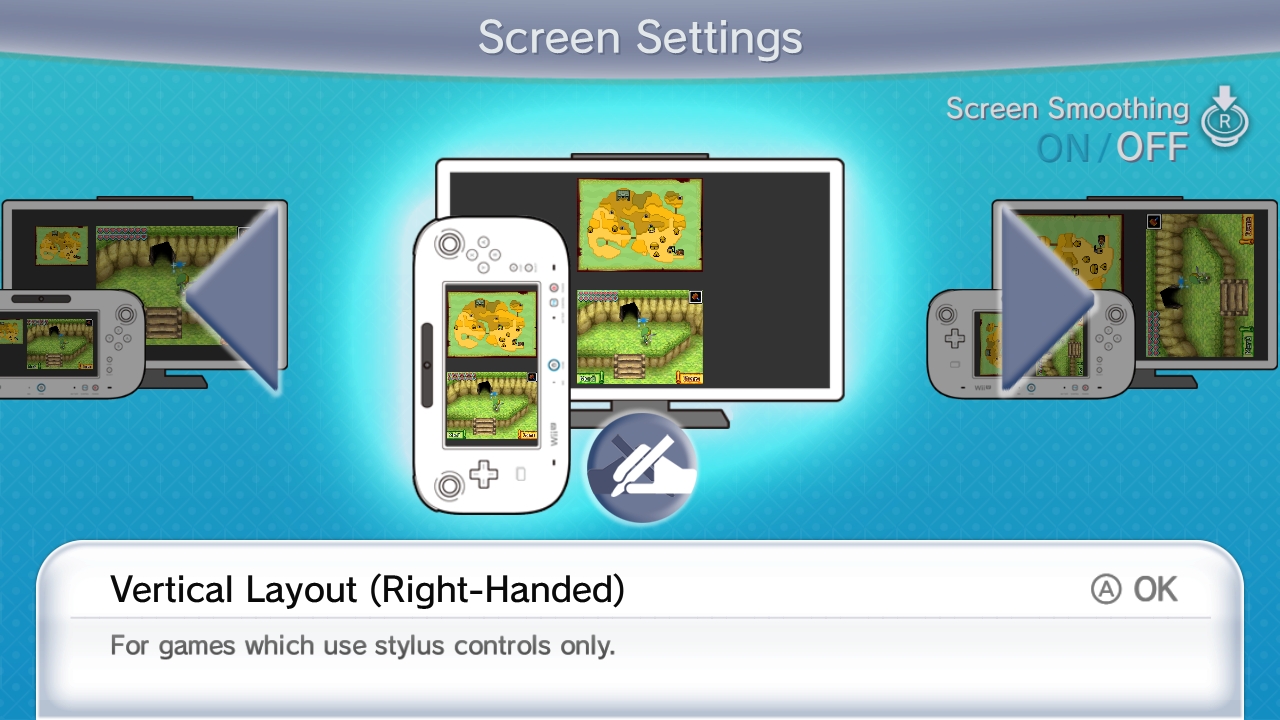
If you follow these advice, then it will play mostly fine, and you also get all possible screen settings. You can split things, so that the Nintendo DS touchscreen is fully on the Wii U GamePad and the upper Nintendo DS screen gets displayed on the TV. Otherwise there are six different configurations for having both screens on the GamePad (and TV), where four of them come with support for left- and right-handed modes.

Screen Setting, Vertical Layout (Right-Handed): For games which use stylus controls only. Screen Smoothing OFF.

One even lets you use the Wii U GamePad vertically, which makes best use of the screen size and can be quite comfortable with the GamePad resting on your lap or a table. The option to have one screen in a bigger size and the other small next to it is also interesting. Since the upper screen gets mostly used for displaying the map in the Nintendo DS Zelda games, it's a good choice for using the GamePad horizontally, at least for the most part.

However, there is no option to display both screens right next to each other without a gap. This is fine with Phantom Hourglass, because the game takes a gap into account for displaying scenes that go over both screens, e.g. certain boss battles or the shooting gallery. But Spirit Tracks doesn't do the same and here it would have been nice if there were an option to remove or reduce the gap, so that these scenes look better. But this was already an issue with the original game.

Another problem with the original Spirit Tracks have been frame drops on the Nintendo DS, e.g. when being attacked by those tanks. But the game runs smoothly on the Virtual Console, which is fantastic.

Sadly, all those display options came at the expense of the usual controller setting, where you can freely change your button layout. For some reason this not possible with the Nintendo DS games any longer. Of course, with Phantom Hourglass and Spirit Tracks it's not a big deal, because you will play via the touchscreen the entire time. But having the Virtual Console menu on ZR can be an issue whenever your GamePad rests on something while playing, because then the menu might be accidentally triggered. And here it would have been good if you could simply assign it to a different button.

All things considered, Phantom Hourglass actually plays quite nicely on the Wii U GamePad, where it was fun to play through the game via the Virtual Console once more. Spirit Tracks on the other hand doesn't get along with the microphone of the Wii U GamePad, especially when you want to play the Spirit Flute. Already with the Whirlwind item you will notice that you have to blow quite strongly in order for it to work, but playing the flute feels like a physical impossibility, because the GamePad won't allow for continuous blows...

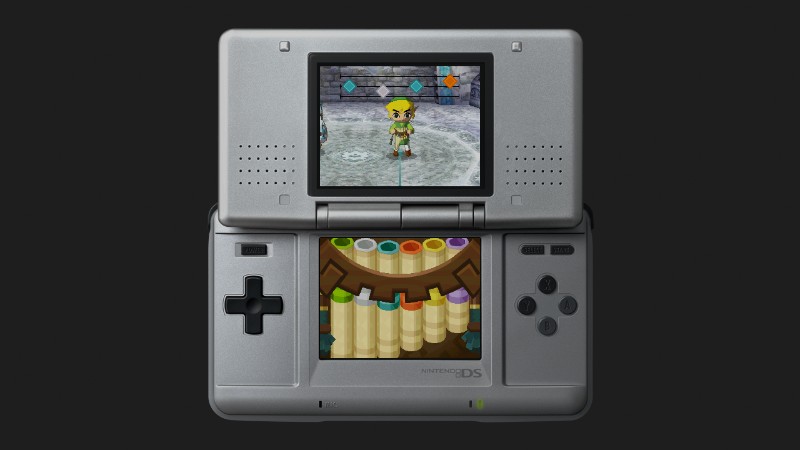
an old Nintendo DS against a black background with a Spirit Flute play on the screens

There already have been similar issues on the Nintendo 3DS, which may be caused by the integrated noise cancellation of the microphone, which makes it impossible to play the Spirit Flute like you could on the older Nintendo DS models. And this creates a frustrating obstacle, where you just want to put the game aside... The Wii U also doesn't give you any options for configuring the microphone, but Nintendo really should have done something to make the game work, e.g. a button to simulate microphone input.


Curiosities

If you're familiar with Phantom Hourglass, then you will know about the infamous puzzle where you had to close your Nintendo DS. The Nintendo 2DS already had the same problem and the solution is also the same: you activate the Sleep Mode, which in this case gets achieved by calling the Virtual Console menu. This gets noted in the Virtual Console manual, but there are no hints about this in the game, which will certainly cause some confusions.

Also confusing may be some orphaned features in the games, specifically the Battle and Tag Modes. This gets addressed in the manual as well, but nothing was done to make them inaccessible, unlike in Oracle of Ages & Seasons on the 3DS Virtual Console, where you couldn't talk to the Blue Snake and so on. Quite the opposite, Phantom Hourglass even lets you open the Wi-Fi settings of the Nintendo DS! This is of no use, of course, because you can't play Virtual Console games online on the Wii U. But in the least Nintendo could have removed the menu entries in the game, so you won't be baffled by it in the first place.

The Tag Mode, which basically was a predecessor for StreetPass, also can't be used any longer, so you won't have the possibility to trade treasures and Ship Parts with other players. This may not seem like a problem at first, because you technically can find everything on your own, but the probabilities for them are biased, so that you will find certain treasures more often than others, which is different for every save file. This was to encourage you to use the Tag Mode and quite a problem a in Spirit Tracks, where getting all the necessary treasures for the Train Cars is a grind otherwise.

two chests waiting at the end of the Temple of the Ocean King, the clock shows 25:00, the best possible time

Luckily, you can use the Virtual Console Restore Point to put your luck a little more in the right way by reloading your game right before getting a treasure, until you get whatever you need. But even such methods will only help you so much.

The internal clock of the Nintendo DS also takes a role in collecting things, where the shop offers of treasures and Ship Parts change every day and the Masked Ship only appears at certain times. The Suspension and Restore Points will save the time when they got created, however. This makes sense from a technical point of view, but can be confusing at first. To synchronize the internal clock of the Nintendo DS emulator with that of your Wii U again you will simply have to reset the game via the Virtual Console menu. But don't forget to save within the game before that.


Conclusion

Phantom Hourglass and Spirit Tracks were clearly optimized for being played on the Nintendo DS and if you have the choice, then you should go for the originals. Thanks to the extensive screen settings it's still quite enjoyable to play Phantom Hourglass on the Wii U, but the same can't be said about Spirit Tracks, where Nintendo needs to do something about the microphone issues.

The Good:
  • Lots of screen settings
  • No drops in the frame rate
The Bad:
  • Microphone issues in Spirit Tracks
  • No controller settings
  • Orphaned multiplayer functions

Sunday, November 3, 2013

999 Hits in the Sword Training of The Wind Waker, Phantom Hourglass and Spirit Tracks

Oh, the sword training... The minigame itself isn't that hard and even getting the Heart Piece/Container is not a big problem. But to truly 100% the game, you have to go a little bit further. Well, at least in The Wind Waker and Spirit Tracks that is. If you score 999 hits in The Wind Waker, Orca stops the game and now keeps calling you "Master" by title, whenever you talk to him. And in Spirit Tracks scoring over 900 hits (you might as well go for the 999 maximum) makes you the commander of the guards. They will then call you captain, which is kind of funny.

While normally minigame records like this don't count torwards the 100% rating, in this case they do, because they unlock something new to the game - a title and different reactions from people. Years ago I didn't count these things as part of the 100% rating, because you didn't get an item from it (and because I hated the thought of playing these terrible minigames for so long). But since I always claim that I 100%ed all Zelda games (which is a very fishy statement to begin with), I decided to catch up on these records after all. Luckily there are tricks, which make these games easier.

The Wind Waker:
The trick is to use the shield. Hit him until you hear the counter attack sound (whenever the A-button appears on the screen), but instead of countering you simply use your shield to block his attack. Repeat until you get the 999 (might take a while...) It worked best for me by pushing him into a corner, but be careful not to hit things in the environment. Works both in the GameCube and the HD version.

Spirit Tracks:
Watch this video. You have to get the attacking guard get stuck on the wooden posts in the lower right, while you attack one of the guards in the lower left. The third guard remains passive, because he waits for the stuck guard to attack. This only works before getting 60 hits, because otherwise the other guard will attack you as well. It's hard to pull it off at first, but as soon as you get it right, you can quickly score the 999 hits in a couple of minutes by just mashing the touch screen.

It happened to me twice that like after 500 hits the captain complained about me leaving the room and put me in the center. If this happens, it's Game Over. You have to try to keep the input on the touchscreen at a steady rate, which can be hard, but don't give up.


Phantom Hourglass is probably the only of the three sword training games, where it's not a problem to get the 999 hits by playing the game as intented. However, there's no reward for scoring 999. He doesn't treat you different, you don't get a different name or title, he acts the same way as he would when you score over 200. So, there's no need to score the 999 here. One of the many reasons, why I prefer Phantom Hourglass over Spirit Tracks... less bullshit.

If you add minigames, try at least to make them fun and don't add any ridiculous unlockables for ridiculous scores. Thank you, Nintendo.

Monday, May 23, 2011

Phantom Hourglass vs. Spirit Tracks


Well, I was browsing through Zelda Universe forums the other day and saw this discussion about whether Phantom Hourglass or Spirit Tracks is the better game. And the opinions in there are sometimes a little extreme, calling Phantom Hourglass "the worst Zelda game yet" while putting Spirit Tracks on a pedestal in the same sentence. I couldn't agree less, which is why I thought I could make a little comparison here on Hyrule Blog. Actually I compared both games a lot already when Spirit Tracks came out and also when I replayed the game a couple of months ago, so this will cover just some of the major points and most of it will be repetition.

Round 1: General Game & Presentation

Story, visuals, music, controls... This is where Spirit Tracks was much better developed, which is probably the main reason why most Zelda fans prefer the game over its older brother Phantom Hourglass. With Phantom Hourglass Nintendo primarily focused on establishing a Zelda game on the Nintendo DS with its basic visuals, gameplay and controls. Especially the touchscreen part was really important. But the rest of the game came short. With Spirit Tracks on the other hand they were able to use everything from Phantom Hourglass as a base, so they could focus on all the other things and even improve everything from the predecessor. So it's only natural that Spirit Tracks takes the upper hand in this department. The story is much more interesting, the game has a much fuller soundtrack and it tried to improve several aspects of Phantom Hourglass.

About the soundtrack, I always thought that Phantom Hourglass with its more minimalistic tracks created its own unique charme. Like the island theme, I totally dig that one, even though its like just three notes or so. I don't know, I still liked it. Of course the music tracks of Spirit Tracks are much better, but part of this charme was lost on its way. And Linebeck was one awesome character, still having princess Zelda as your ghostly companion still beats him. You never interacted with Zelda as much as in Spirit Tracks, not counting the not so official CD-i games.

The graphics are mostly better in Spirit Tracks, but the game also suffers from lag, for example if you get attacked by the pirate tanks the game usually slows down. I don't know if this is still the case on a Nintendo DSi or 3DS, both having more horse power, but it's a problem on my Nintendo DS Lite. They also tried to improve the touch screen controls, now rolling is done by double tapping. But while it's now easier to roll, I accidently rolled into enemies many times, when I tried to hit them with fast strikes. And at some parts of the game (like the battle on top of the Gannon-Train) my touchscreen just went crazy and nothing worked anymore. I only beat the final boss fight once so far because of this. This might have been a problem with my screen protector, but it's definitely not a problem in Phantom Hourglass, there the controls always worked fine. Still, Spirit Tracks wins this round.

Winner: Spirit Tracks

Round 2: Boat vs. Train

My vote goes definitely to the boat. It's faster, you can warp all around the map and the ocean visuals are more suitable for the Nintendo DS. The train might haven been an interesting idea, but the execution was just terrible. It's too slooooooow. You spend tons of time in this game just with going from A to B. Most other Zelda games including Phantom Hourglass established some kind of fast warp system, which saves you the pain from unnecessary travelling. But those warp gates don't really help and the train is just awefully slow. It should go as fast as in the sequence, where you play Pacman with Dark Trains in the Dark Realm, then I wouldn't complain. And while having worlds like Forest, Snow and Fire Realm might be more interesting than just a bunch of islands, it all looks just so ugly. Tons of 2D sprite objects and super low resolution textures. I'm not a graphic whore, but it's just that the ocean world of Phantom Hourglass was more suitable for the Nintendo DS's power and looked therefore much more harmonious. You really notice that in the Ocean Realm of Spirit Tracks, probably the best looking train part.

Winner: Phantom Hourglass

Round 3: Freedom & Exploration

The train idea also came with the disadvantage of making Spirit Tracks much more linear. It's literally Zelda on rails. And everyone, who has read some of my posts on this blogs, knows how much I despise linearity. Not counting the sidequests this game is absolutely linear from start to finish, from exploring most parts of the so called overworld, over the order of the dungeons to the path through the dungeons theirselves. It isn't as bad as Twilight Princess, but it certainly doesn't leave you many options. Phantom Hourglass on the other hand likes to give you some choices. First half of the game might be linear, but if you go for the third sea chart, you can also chose to get the fourth sea chart in the same run. It might be much more difficult with about five minutes less on the clock and withouth the Bombchus and the Grappling Hook, but it's possible. And if you manage to do so, the entire second half of the game is an open world. You can visit all except one island in any order and play the dungeons in any order. Playing Mutoh's Temple first, then go for the Ice Temple and visiting Goron Island and Temple at the very end? Sounds impossible, but I did exactly that just for fun! And yes, it really was fun, freely exploring open worlds and playing dungeons out of order is much more fun than following a predestined path all the time.

Okay, to cut Spirit Tracks some slack, discovering and exploring all the hidden stations was really fun, too. But Phantom Hourglass also has some optional islands, so it is still the winner in this category.

Winner: Phantom Hourglass

Round 4: Dungeons

Both in Phantom Hourglass and Spirit Tracks all of the normal dungeons are quite short, not too challenging and mostly nothing special at all. The focus was clearly on the master dungeon, the infamous Temple of the Ocean King and the Tower of Spirits. Both dungeons require you to return to them many times, they unlock more areas on the overworld, where the next normal dungeons are hidden. By beating the normal dungeons you usually open another section in the master dungeon and the process repeats itself. They also serve as your first and your final dungeon in the game. This is quite a unique concept in the Zelda series and both games approached this differently. Invincible Phantom enemies are part of both dungeons, but one focuses on a time limit, while the other focuses on controlling a Phantom. One goes down, one goes up. And so on.

Most people tend to hate the Temple of the Ocean King, mainly because it is very repetitive. You have to return to the dungeon over and over again and you have play the same stuff over and over again. But actually this isn't really the case, there are many shortcuts and because of this no playthrough should be like the other. There is even a warp point, that let's you skip half of the dungeon. And like I already said, you can get the third and fourth sea chart in one run. It might be a little bit difficult to do this and the time might even run out while doing so. But people also complain, that the game is way too easy, so this little challenge should be welcomed. And with that you don't have to return to the dungeon until the END of the game, where you can already slay the Phantoms with your Phantom Sword. You can play three normal dungeons without having to return to the Ocean King Temple. In my eyes this should really add another perspective to all the complaints. If you know the dungeon, it's not a problem. It's little bit like in Majora's Mask. There people complain about the time limit. "Zelda with a time limit is not fun." But the game never really was about having a time limit, but about playing with time. If you know how the time system works, you should have never any trouble with beating a dungeon or a quest. It's the same with the Temple of the Ocean King. If you know the dungeon, you really learn to like it and appreciate its concepts. This dungeon is a science of its own, I never studied a dungeon of the Zelda series as much as this one. I've even written an entire FAQ about (speed)running through the dungeon with a full hourglass. I would never do such a thing for any other dungeon in the series, not even the Tower of the Spirits.

The latter tries to get rid of all the complaints about the Ocean King Temple. You don't have to repeat any sections, save for some sidequests, and there is no time limit. It focuses on the Phantom coop gameplay instead, which probably is much more enjoyable than running against a clock. But the dungeon is also less memorable in my opinion. What really makes it great are some very clever puzzles that kept me busy for quite some time. It definitely has some of the better puzzles in the series. Overall the dungeon wasn't as challenging or fascinating as the Ocean King Temple for me, but I can see why most people prefer it over the Ocean King Temple.

Additionally Spirit Tracks also has some mini dungeons in storage, one of them being a Mini Ocean King Temple, which is definitely great. Yeah, and Spirit Tracks has better dungeon music by simply not playing the cave music of A Link to the Past over and over again. So, overall I'd say Spirit Tracks wins this category, though the Temple of the Ocean King offers the most memorable experience.

Winner: Spirit Tracks

Round 5: Items

Well, this is pretty much old versus new items. Phantom Hourglass just used familiar items and modified them for touchscreen use. But you have to praise the Bombchus, drawing their path on a map was pretty fun and this was actually the first time that this item was useful. And the Hammer was extremely kick ass, even though it was really unbalanced. Spirit Tracks introduced more balanced and new items using the touch screen, but also the microphone. Blowing away stuff with the Whirlwind was surprisingly fun and the Whip has the potential of becoming a new established item in the series. Also, the Sand Staff was a pretty clever puzzle item. On the other hand having a shovel like in Link's Awakening was great and playing the Spirit Pipes in some occasions was really annoying. About the status items, I enjoyed that I could switch between fairies with different abilities in Phantom Hourglass, that was really cool. But Spirit Tracks on the other hand gave me the option of playing in a different outfit, which was also really cool as well. Mhhh, this is really close, so I'd say it's a draw.

Winner: -

Round 6: Sidequests

Spirit Tracks suffers here from really predictable patterns. Bunnies are caught while at riding at train, ten bunnies per area. You get one stamp per area, upgrades and heart containers are gotten in minigames or shops. Force Gems are gotten by transporting goods and people. The only thing that you can basically find everywhere are the random treasures. Because of this you don't really have to search through stations or dungeons, you basically can't miss anything important. Unlike in Phantom Hourglass, where Spirit Gems, Treasure Charts, random treasures and ship parts are all mixed up and distributed everywhere. I especially enjoyed collecting the Spirit Gems and the neat abilities, which you got for them.

Both games suffer from stupid random items. Actually Phantom Hourglass handles the random system much better, there are very rare ship parts and treasures, but also spots, where it's more likely to find the rare ones. However, due to the larger number of random items (64 ship parts), it gets very tedious and hard if you're down to the last few ones. Spirit Tracks only got 16 treasures and you buy the train cars from the treasures. Much, much better idea, but the totally screwed it up with making some treasures super rare despite their lower price. Prepare for a tedious, repetitive and boring task of playing the same minigames over and over again just to collect enough treasures for all train cars. It wouldn't be much of a problem if they didn't totally fuck up the probabilities. But they did and so Spirit Tracks might be even worse than collecting all the tons of ship parts in Phantom Hourglass.

However, in the end Spirit Tracks has much more to offer in the sidequest department. Especially all the optional mini dungeons like the cool Lost at Sea Station, which emulates some classic Ocean King Temple gameplay, are really awesome. Or the "Take 'Em All On!" challenge in Hyrule Castle Town, where you even can fight all the bosses in a row. Phantom Hourglass might have the better collectible quests, but it can't compete with that.

But I enjoyed the minigames in Phantom Hourglass more. Especially the target shooting, I spent hours with this game (collecting ship parts). Spirit Tracks copied most minigames from Phantom Hourglass, but made them less fun. The target shooting for example takes too long and there's quite some lack. So, i guess this is a draw.

Winner: -

Round 7: Multiplayer

Both tried and both failed in their own way. I already did a "Zelda and Multiplayer" special, so this is the short version. Phantom Hourglass can be played online, but overall the Phantom gameplay isn't much fun. Spirit Tracks has a great fun looking Deathmatch style gameplay, which I would prefer, but it can't be played online, which renders the whole thing useless for most people outside of Japan. If the multiplayer of Spirit Tracks could be played online, it would be perfect, I probably would even play this from time to time. But it can't be played online, so this is again a draw.

Winner: -

-----------
The bottom line is that in my opinion both games are equally good or bad. What was done right in one game, was done wrong in the other, and vice versa. Overall both are mediocre Zelda games, lacking in difficulty and replay value and screwing up sidequests with randomness.

Thursday, December 30, 2010

Replaying Spirit Tracks


A good Zelda game has a high replay value. A Link to the Past, Link's Awakening, Ocarina of Time... you could play those games dozens of times and they'll never get boring. They're awesome and fun, they offer enough freedom and non-linearity to encourage some experimenting and even speed runs. While some Zelda games are just fun to replay, others might "force" you into replaying them by offering a 2nd Quest and content, that can only be gotten by replaying the games. The Wind Waker and the Oracle games are good examples for this. Sometimes you replay a Zelda game, because you missed an item (I hate missable items), or because it was re-released for a newer system and you don't want the new copy to remain untouched. There are many good reasons to replay a Zelda game, but some of them are just bad in this department. Especially the last ones. Zelda games lately have no replay value and that's sad.

I finished each Zelda game at least twice, I even replayed Phantom Hourglass out of curiosity. The game offers quite some non-linearity, which is rare in modern Zelda games, and I wanted to test if I can get the third and fourth sea chart in one run, so I could play Mutoh's Temple first, then the Ice Temple and the Goron Temple at the end before returning to the Temple of the Ocean King. And it worked. Adding some non-linearity to games is usually a good thing, because it can produce a new experience each time you replay the game.

And achieving the 100% for a second time was really dull. The random factors just make it a very boring, repetitive and tedious experience. Actually the randomness was much better handled in Phantom Hourglass, because there were spots, where you could specifically get rare ship parts more easily (like scoring over 2000 points in the archery or the two treasure chests at the end of the Ocean King Temple). The problem here was the high amount of ship parts, because the chance of getting a specific part is very low. So, if you were down to a couple of missing parts, getting them could take forever... And this really destroys the replay value of the game for completionists.

Well, since I replayed every Zelda game, I recently thought I should do the same with the newest installment, Spirit Tracks, even though I never really wanted to. I usually replay a game willingly if I really liked it. Heck, I even replayed Metroid: Other M shortly after my first playthrough and the game wasn't very good. But for some reason I didn't want to replay Spirit Tracks and that reason is called tediousness. All the slow train travelling and collecting all the treasures for the train cars again makes replaying very unattractive. In Phantom Hourglass the sea travelling was okay, the distances were really short and you could warp all around the sea. But the train travelling in Spirit Tracks takes A LOT of time. You can't just simply go from A to B by using some warp like in most of the other Zelda games and this artificially lengthens the play time with dull travelling.

And then there's the treasure hunting. Actually on the paper the treasure system is a lot better than collecting the tons of ship parts in Phantom Hourglass, because there are only 16 random items and some of them can be even gotten in determined spots. But Nintendo screwed it by making some of your treasures extra rare, which varies with every save file, because they wanted to support trading treasures via the Contact Mode that way. In Japan, where everyone runs around with a Nintendo DS and where they play Zelda in the subway, this might be okay... but good luck finding someone for trading treasures here in Europe or the United States. And it doesn't work online. So, all you can do is try to get all the treasures yourself, which can take a while and is very repetitive. This time, one of my rare treasures were the White Pearl Loops... you need more than twenty of them and I still haven't gotten enough. And I can't see that stupid sword training minigame (which is the easiest way to score some 150 rupee treasures) anymore. I have the Platinum Membership in the Beedle Shop (which is also absolutely ridiculous), but not all train cars yet...

But on the bright side, I got a better look at the game. For example I noticed that all the other side quests are far better distributed than I thought they were. Originally I dodged most of the side quest until the end of the game because of the slow train riding, I was rushing from dungeon to dungeon. And then at the end I had a total sidequest overload. But that's something that can happen in all the Zelda games, when you're playing them for the first time. The main quests are always the obvious choice, a new dungeon is far more exciting than collecting some treasures. But when I replay a Zelda game I always focus to finish all the sidequests as early as possible. And that way I noticed that there are enough side quests before each dungeon and each section of the tower, which is great.

Little Update: Another thing I haven't noticed during my first playthrough was, that if you blow the whistle after picking up one of the Tears of Light in the Dark Realm, your train goes EXTREMELY fast. I love that and it also makes battling the Dark Trains a lot easier. That speed update should be somehow available in the main game, it would be tons of fun. This time I haven't saved after battling the Gannon-Train, so I can always replay the Pacman part. Fast is fun.

So, what we learn here, is that a tedious side quest can be a real replay killer, if you want to go for a 100%. It's the same with The Wind Waker for example and all it's figurines, that's one aweful sidequest. The Minish Cap is actually short and fun, which is why I replayed it like three times, but the figurines there AGAIN were totally annoying and you basically waste a lot of time there in the lottery just to get the 100% again, while the rest of the game is long finished. So, Nintendo, please stop adding random factors and repetitive tasks to side quests. Zelda shouldn't be some grinding game. Also, a Zelda game shouldn't give you the feeling that it's a long and boring task, like The Wind Waker and Spirit Tracks did with all their sea and train travelling. A Zelda game needs to be more dense.

Miyamoto recently acknowledged in an interview with pocket-lint, that they have to focus more on the replay value with Skyward Sword:

“What we are focused on is creating gameplay mechanics so the gameplay experience feels very dense. In fact, the overall experience is going to feel more dense. We hope that people will want to go back and replay the game once they finish it”.

That really sounds good. Less is sometimes more. Have a smaller overworld, but rich in detail, action and exploration. Have less sidequests, but quality ones, not that random crap. Replay value is very important to every game, not just Zelda. What's a game worth, if you can only play it once and then it catches dust? It definitely wasn't worth the money spent on it. And the sooner the Zelda team realizes the importance of replay value, the better for the Zelda series.

Sunday, March 14, 2010

Spirit Tracks Collector's Guide

Last and eventually least is the Prima Collector's Guide for Spirit Tracks. With its 320 pages it's the thinnest of the three guides and the hardcover is green this time.


I like it how they used a rail pattern for the rim of the cover. The map is this time printend on some thin parchment paper. It's not as awesome as the cloth map from Twilight Princess, but I like it much more than Phantom Hourglass' poster map. However, there aren't any other extras this time around, it's only the map.


There some things I noticed, while skipping through the guide. What I didn't like was that they didn't have any own maps, they just used the ingame maps for everything, which sucked. But the biggest impudence is that they used their self made maps, which they have drawn ingame on the Nintendo DS, for the dark Torch Phantom rooms, that don't have an ingame map. They look as bad as it sounds and they're missing quite some information like treasure chests hidden in the dark. For example in the Lost at Sea Station, they've missed the chest in the east corner of B2. And one of the dark floors in the Tower of the Spirits was drawn totally wrong.

Talking about missing treasure chests, this time they even listed a chest, which isn't in the final game. I looked for all chests, that have to be excavated with the Song of Discovery and they listed one in the Goron Village, the place on top of the hills with the three pots. It's a suspecious place and I thought there would be a chest hidden there too, but you can play the Song of Discovery from every angle there, it won't show up.

And there's a flaw with the ultra-rare treasures, the Regal Ring and the Alchemy stone. While you can win them in some minigames or the lottery, the rest of the places are fixed. Like you'll always get a Alchemy Stone in the Snowdrift Station and you'll always get a Regal Ring in the Lost at Sea Station (try it for yourself). But the guide always says "random treasure" in all treasure location, except for those, where you've been told beforehand what you'll get like in Linebeck's Regal Ring quest or in the Disorientation Station. It doesn't even really hint that you can get one of the two rarest treasures in some of the locations, which is not helping much. There are also no tips on how to get certain treasures, if you're missing some of one kind.

And the guide doesn't cover the third level of the amazing "Get 'em all on"-minigame in Hyrule Castle Town. It does fully cover the first level, briefly mentions the second level, but there's nothing about the third. You can get a quiver upgrade there, if you don't want to buy it for 2000 rupees in the Goron shop, so it is worth being mentioned. And there's Dark Link, who isn't listed in the entire guide at all. My best guess would be, that the guys, who wrote the guide, weren't able to beat the third level and just left it off from the guide. :D I mean, even if they thought, that there's nothing to get there except treasures (which didn't stop them from covering all the minidungeons), you need to prepare the players for the challenges that awaits them there. Like an "if you try the third level, bring two potions, because you'll face all the bosses". Or at least some strategies for the tougher fights like the one with the three giant pirates.

The most interesting part of the guide for me was the multiplayer section. Since I never had the chance to test it, the description of the gameplay and the six maps was very welcome.

At the end one last image of all three guides together:


I guess, the lesson is clear. If you're looking for a guide to help you with the game, look online. Most guides online are free and more accurate. But if you want a nice collectible item, those guides are definitely a good choice. It's something for the fans.