Showing posts with label Reviews. Show all posts

Sunday, July 19, 2026

Echoes of Wisdom ~ Review Added

the Great Deku Tree

This is to inform you that a new review was added to Hyrule Blog, one for The Legend of Zelda: Echoes of Wisdom. Most of it got written back in late 2024, after I had first played through the game, so I decided to add it into the archive around the time, because it makes the most sense there historically. Here is the link:

Read the Review

All the screenshots were also taken during my first playthrough in 2024, but a lot of them didn't find their way into my Adventure Log. And here it's nice to show off some more, so they don't just rot on my harddrive.

Well, at the time, I wasn't able to finish the article for personal reasons. And it can be tough to write a review when I already have talked so much about a new game, because it feels redundant. Still, I find them to be very valuable, because they collect all my important thoughts from the play logs. But once some time has passed, I need to play the game again to refresh those thoughts, which is what I have done in this case (see here).

There are also half-finished reviews for both Age of Calamity and Imprisonment somewhere in my drafts, where hopefully I will get back to those one day. Sadly, for Breath of the Wild I only have an intro and some notes, while I didn't even bother with Tears of the Kingdom...

PS: I also added a post about the connections to Oracle of Ages, which is also something I meant to write back then.

Tuesday, December 23, 2025

Metroid Prime 4: Beyond (Review)

game's logo + REVIEW

Teased 18 years ago, announced eight years ago, and its development rebooted six years ago... Metroid Prime 4: Beyond has a very long development history and now has finally become a reality on the Nintendo Switch and Nintendo Switch 2. But was it worth the wait? Does it hold up to the reputation of the original Metroid Prime Trilogy? And how how does Sylux fare as a villain? If you have followed my logbook, then you will already have a good idea, but here is the condensed version.

Wednesday, October 29, 2025

Hollow Knight: Silksong (Review)

artwork of Hornet on a rock using bind with the game's logo at the front

The sequel to the beloved Hollow Knight finally released on September 4th this year and took the gaming world by storm. Since its announcement in 2019, Hollow Knight: Silksong became the most anticipated game in the gerne, but can Team Cherry's second game live up to the many years of hype? Well, you already know it can... But let's discuss it anyway.

Friday, May 16, 2025

Captain Toad: Treasure Tracker – Review

game logo

Captain Toad: Treasure Tracker originally came out on the Wii U in 2014 and was re-launched for both the Nintendo 3DS and Switch four years later. Out of the Mario franchise this is probably what comes closest to a Zelda game in spirit. Its idea even had been envisioned as a Zelda spin-off starring Link at first, before they made Captain Toad the main character and integrated it as a mini-game into Super Mario 3D World. But both this and the recent top-down Zelda installments embrace a cute diorama style, where you're looking onto a small toy world.

Now, I had played and completed the Wii U version about ten years ago and recently felt like replaying it on the Nintendo Switch, also because its DLC was discounted and seemed like the ideal thing to get from my last remaining Gold Points. And since I never had reviewed the original in any way or form, it is now time to make up for it, here on Hyrule Blog.


No Jumping!

The idea of the game is quite simple: it's a platformer where you can't jump. So, if you move off a ledge, you will just plummet down on the square right below (or to your death). You need to use things like slopes, staircases, elevators or ladders to get to higher grounds, where in many ways this is similar to your classic Zelda top-down gameplay. But Captain Toad can't hit enemies, unless he throws something at them (usually turnips) or picks up the Super Pickaxe power-up, which makes you invincible for a short period of time and lets you break through certain blocks.

Captain Toad and Toadette on top of small ruin, about to get a star - this is the start of episode 2

What stands out the most are the levels themselves, however, where the majority of them was designed as these little dioramas, a chunk cut out of its environment, which you can freely rotate. A big part of the gameplay is exploring these miniature worlds in close detail, not just with your playable character, but also with the camera. Things may be hidden around a corner, where you don't see it initially. And this is really the core charm of the game.


Short & Sweet

With the nature of these dioramas comes a shorter level length overall, but they make up for it with replayability, or at least giving you an incentive to play them multiple times over. It's a very addicting game to complete, where it starts with collecting three crystals per stage. These stay collected even when you die, but you will have to finish the level. And they are used to unlock more stages, where going forward requires a certain number of them, but usually not all of them.

Then there's a hidden task, which gets revealed after finishing a level once, but often it's fun to figure it out beforehand. This can be things like collecting a number of coins, finding a hidden Gold Mushroom, defeating all enemies, activating switches only a certain amount of times, and so on. Collecting all three crystals and clearing the hidden task marks a level as completed.

Your record of collected coins is also stored per level, where it can be fun to top those, but the coins aren't required for anything outside of the hidden tasks. 100 of them will give you an extra 1-Up and that's it.

Captain Toad looking out of a window in the Walleye Tumble Temple

In addition, there is a "hide and seek" game with the Pixel Toad, where you have to go around the level to look for him. Often he is hidden quite cleverly, where you even need to progress in the stage a bit to reveal the spot. On the Wii U this feature required you to use the Toad amiibo, the later versions unlock it after the stage got finished once.

And if that's not enough to do for you, you can also challenge yourself by completing the stage in a given time. That can be surprisingly fun, because it's often like a puzzle in itself to figure out the fastest route. But you also need to be quite efficient in multi-tasking, which can lead to some frustrations (more on that later).

Both the Pixel Toad and the time trials are completely optional, so there is nothing to unlock from them, except for a mark on the cover of the corresponding book, which appears once you've done these tasks in all of its stages. The books are called "episodes" and there are three of them in total. The first two have 18 stages each, and the third one has 28 stages in total. This includes boss fights and some special levels, where you drive around in a mine cart and shoot turnips.

You will swap between Captain Toad and Captain Toadette between these episodes and within the third one. There is even a bit of a story, starring a big bird named Wingo, who steals Power Stars and riches from them two, usually leaving one of them alone and in search for the other. But it's very simple, the usual Mario stuff.


Throw, Turn & Touch

Now, for a game that is so strikingly simple, its controls are irritatingly overloaded, so much so that it often feels like you need three hands to play it. Controlling the camera is very important, where this gets primarily done with the right stick, like in many other games. And this poses the first problem, because in order to pick up things or sprint you have to press or hold either A, B or Y (the latter can also turn your headlight on and off for some reason), which means you have to change between those and the right stick all the time.

at the front of the Star Express train

When playing the time trials or some of the bonus challenges, you often need to hold down one of these buttons to run faster, but you will also need to adjust the camera constantly... Well, some camera work can be done with the shoulder buttons (mainly L and R to rotate), but it's not as precise and intuitive as using the stick. And they also don't let you change the camera's Z-axis. The solution is to alter the button mappings in the system settings, so you can perform the basic actions with ZL or so, where the game doesn't have any control options outside of inverting the camera. And that isn't ideal.

On top of all that, the game was originally intended to be played with a touchscreen, so there are a lot of interactions in the environment that can only be achieved by touching things, like special platforms (and even the Pixel Toad). Enemies can also be stunned by touching them, which can be critical later on. If you don't play in handheld mode, then there will be a motion-controlled cursor, where you trigger things via ZR. If you've played Super Mario 3D World on the Nintendo Switch, then you will be familiar with this, because they have used the exact same method there. And this works surprisingly well, given that you perform this on its own. The problem arises from when you have to multi-task in the game's various challenges. Then you have to run, turn the camera and activate things with the touchscreen / cursor all at the same time, and this can get a bit overwhelming...

a pretty sky level where the ground is made out of three giant turnwheels

Another problem came from ladders, where sometimes you stop climbing them, even though you keep pressing in the same direction, because of the camera. That's a bit annoying. What can also be annoying are the wheels, which are automatically grabbed even when you are just running... Often you just want to run past by them, but then get stuck on them. At least they are much quicker to use on the Nintendo Switch thanks to motion controls. The propeller platforms are also gone entirely in the Switch version, which required you to blow into the microphone...


Bonus Book

After completing all three episodes, it unlocks the "Bonus Episode", which contains a number of different stages. First and foremost, there are four levels based on another Super Mario title: Super Mario 3D World on the Wii U and Super Mario Odyssey on the Nintendo 3DS and Switch.

The former were just levels taken from that game. They were slightly modified, so you can play through them without jumping, and weren't all that exciting. Meanwhile, the Super Mario Odyssey stages were all completely new and offer two true highlights with Secret of the Inverted Pyramid and Updown, Downtown. So, it's a very good trade overall.

Inverted Pyramid stage

That being sad, it still leaves a sour aftertaste that this game's connection to Super Mario 3D World got cut off like that. After the credits of the third episode have rolled, you could see how Captain Toad enters the Sprixie Kingdom to continue his journey there. So, it was set up as a prequel, which made sense, considering that both games share a lot of assets. And while Captain Toad also appears in Super Mario Odyssey, it was really 3D World that first featured him in a playable role that then spawned this game.

Ideally, the ports would have retained connections to both titles somehow. And even if the Sprixie Kingdom stages weren't that great, they could have remade the six original Captain Toad levels from 3D World instead and modified those a bit.

Speaking of modified levels, that's the other main part of the Bonus Episode. Seven of the existing stages got remixed here with new objectives. In the four "Toad Brigades" you will have find three other Toads, who will then follow you and need to be protected. And in the "Mummy-Me" variants you are chased by this game's version of the Cosmic Clones from other 3D Mario titles, so they will follow your every move and you can't ever stop for longer than a second.

Mummy-Me chasing Toadette in front of a giant, red dragon

This includes a variant of the first Draggadon encounter, the dragon boss that you've probably seen before from Nintendo's promotional material around the game. And at this point this boss has really overstayed its welcome, because one of these fights can be found in every single episode. If you also replay the levels for the target times, then you will have to deal with him eight times at minimum...

The "Mummy-Me Maze Forever" then takes things to the utmost extreme, where this a 50 floor long trial dungeon, something all too familiar to Zelda fans. It's that slap in the completionist's face that Mario games often like to do at the end and I will talk a bit more about this in a separate post...

Otherwise, the Bonus Episode also lets you replay all three prologues, as well as all the Coins Galore bonus stages, which appear from time to time and let you collect lots of coins (which are only good for adding lives). There are no Pixel Toads to seek in the entire episode, but it still wants you to speed-run all of its levels, with the exception of the Mummy-Me Maze Forever (luckily). So, all in all there is quite a bit to do in the game, which can keep you busy for up to twenty hours.


Track Together

The Nintendo Switch version comes with two two different cooperative modes, which can be played together locally: Assist Mode and Adventure for Two. The latter was added in the 1.1.0 update, so you can't use this out of the box.

In Assist Mode the two players have to share a set of Joy-Cons. The main player will use the left one and the assisting player the right one. As the assist you are in charge of the motion-controlled pointer, but you can also throw red turnips to defeat enemies, which is basically cheating in certain levels. So, use this mode to make your life easier with any of the game's challenges. Both players can control the camera, but player 1 gets priority here.

Captain Toad (wearing a crown) and Purple Captain Toad hiding from Hammer Bros. in uptown New Donk City

Adventure for Two on the other hand really lets you play together, where for most of the game the second player is represented by a purple Captain Toad. The camera stays centered on the first player, who again has camera control priority, and therefore this mode can get a bit frustrating for the second player, because you might end up out of view.


A Treasure

Captain Toad: Treasure Tracker is a fantastic, little game. Other than the fact that you sometimes have to control three different things at the same time, it's highly recommended for everyone who is looking for a charming, slow-paced, puzzle-focused adventure title. The game also sells on a lower price point and will get a free update for Nintendo Switch 2 on June 5th, so you can't go wrong here.

Thursday, February 20, 2025

Donkey Kong Country Returns HD (Review)

title screen, press L + R to start

Donkey Kong Country Returns has a similar history to Hyrule Warriors when it comes to its three different releases. It first came out on a console, the Wii in this case, and then later received a port on the Nintendo 3DS. That port made things easier on you and also offered new exclusive contents, but it it looked worse and halved the frame rate to get the game even running on the smaller system. Some years later you get the "definitive edition" on the Nintendo Switch, which offers the improvements of the Nintendo 3DS version without the downsides in the graphical department. And that's very nice to have, but are there really no compromises...?

The port was done by Forever Entertainment, a fairly unknown Polish studio, where this is their first time working for Nintendo. It was completely rebuilt in Unity according to Digital Foundry, where – for a Unity game – the performance is impressive overall, but it doesn't run as smoothly as Tropical Freeze does. You will encounter dips in the frame rate here and there, which you may not even notice, but they are there. This is still much, much smoother and playable than the 3DS version was, but it's not quite on the level of the Wii version.

two giant spiked boulders looking impressive in HD

And there is one major downside over both its previous versions: the long loading times, which even exceed those in Tropical Freeze. When playing the game normally this isn't a big deal, but it completely breaks the Time Attack mode, where they haven't bothered with fixing its main flaw. If you die, it will put you at the latest checkpoint with the timer still running, which is about as useful as the rewind feature in Nintendo World Championships: NES Edition, meaning that it's completely pointless whenever you're going for the best times. And if you chose "Retry", it will load the entire level again, which is where the loading times will make this very tedious. Too tedious. This is something that they already had overhauled with Tropical Freeze and this would have been a much needed improvement for Returns HD as well.

Overall, it seems like the port was based on the Nintendo 3DS version, which means that it comes with all of its improvements, but also with most of its flaws. It certainly looks better and has a much higher frame rate and resolution. You also have better control options, where the left analogue stick and the D-pad are active all the time and you can switch between them whenever you want, as you would expect with such a game. But there are some rough edges otherwise.

For example, the final boss still doesn't drop a shadow, which was a critical indicator for landing the last hit without being hit, making this boss fight very frustrating in Mirror Mode. Most of the enemies got their shadows back on the Switch version, though, so this feels like an oversight.

Professor Chops on a counter in a temple displaying the plus button in a speech bubble

And the Super Guide pig still shows up everywhere whenever you die eight times in a level, even in the very challenging temples, which is just annoying. They should have given you the option to turn it off completely. Or at least hide the Super Guide in Classic Mode, because whoever plays in Classic Mode obviously doesn't want any help. At least the game never punishes you in any way when the Super Guide has appeared, unlike New Super Mario Bros. Wii and alike... (And it never did.)

Speaking of Classic Mode, the Nintendo Switch also comes with what's now called "Modern Mode" and works exactly like the "Normal Mode" in the Nintendo 3DS edition. So, you get one additional heart per Kong and there are other helpful items found in Cranky Kong's shop, where the inventory space was even increased now. Switching between the modes is not possible.

If you want to play Returns in it's coop mode, however, then you will face one of the biggest issues from the Nintendo 3DS version: there are no lingering bounce "boxes" left by enemies any longer. On the Wii it was possible that both players can jump off the same enemy with the correct timing, because there is still something to bounce off from after an enemy gets defeated, for a couple of milliseconds. This was missing on the Nintendo 3DS and now it's missing on the Nintendo Switch as well, making some of the harder levels nearly impossible to play cooperatively.

with of the silhouette levels with thorn ranks in the foreground and a fiery background

There are also some general issues with the game that never were fixed in either iteration, like how you can't repeat puzzle rooms without killing yourself. And the collision detection with enemies and obstacles feels overly tight, where it could be more forgiving. But that's all debatable, so there might be no need to change anything here. And some aspects are general design flaws with the game that cannot be easily fixed, like the blowing mechanic, which wasn't brought back for the sequel.

Anyway, with all this said, it's still the best version of the game and this is very nice to have on the Nintendo Switch, right next to its younger sibling, Donkey Kong Country: Tropical Freeze. Being able to play both games back-to-back on the same console in 1080p and (mostly) 60FPS is a treat. And this also allows you to play the eight additional levels from the 3DS in HD for the first time, which is lovely and makes some of them shine a bit more.

near the end of the Robot Factory level with the giant DK robo assembled in the background

Whether this justifies the full price point or not is a different question, however. In the face of Metroid Prime Remastered, which is one of the best-looking games on the system, while costing only 40€, this doesn't make any sense. Both of these were games by Retro Studios from the GameCube and Wii era, and their Nintendo Switch remasters were treated very differently for some reason. But in the overall picture of Nintendo, it's really Metroid Prime Remastered that is the outlier here, while Donkey Kong Country Returns HD is simply more of the usual.

Speaking of the usual Nintendo issues, the credits read again "based on the work of the original development staff", which means that they are completely skipping over the cast from both Retro Studios and Monster Games. This is not okay and never will be okay. Forever Entertainment is not the creative mind behind Donkey Kong Country Returns or any of its contents, but the credits make it look that way.

rolling down a hill with a minicart into the sunset, Mirror Mode

Anyway, if you're a fan of the game and want to replay it in its best version, then you can't do much wrong here. And if you haven't played it yet, it's highly recommended to give it a try, because Donkey Kong Country Returns is a fantastic platformer all in all. Just keep in mind that Tropical Freeze is the better game for the most part. So, maybe wait for a discount.

Thursday, December 12, 2024

Secret Level – Unreal Tournament: Xan (Episode Review)

Xan raising his arm to make the crow cheer

Movie and television adaptions of video or computer game franchises are getting better and better, where the best examples are probably the Super Mario Bros. Movie and the Fallout series from the recent years. Both show a lot of love for the source material, while being fun to watch for everyone, whether you are a fan of the games or not.

Therefore, we can look forward to the Legend of Zelda film with cautious optimism, while in the meantime there are some other good adaptions to watch. One of them is Secret Level, another anthology series from the creative minds behind Love, Death + Robots, where this time the stories are all based on different video and computer games. The first eight episodes were released this Tuesday, on December 10th, offering a wild and violent mix.

Especially the Pac-Man episode is something else, which makes you question how Bandai Namco could have agreed to that... (Update: as announced on the Game Awards, they have been actually working on a new Pac-Man spin-off in this style, called Shadow Labyrinth, so that explains it.)

However, I'm not here to review the series as a whole, instead I want to focus on Unreal Tournament, because the Unreal franchise has been close to my heart for about as long as Zelda. This franchise is pretty much dead, however, so it's bittersweet to get this special episode for around the 25th anniversary of Unreal Tournament. And I really enjoyed it overall.

It essentially serves a prequel, where it depicts the rise of Xan in the tournament, after causing an insurrection of mining robots. They really make you sympathize with the robots, despite the fact that their designs were made less human than they are in the games. The change does make sense, however, and feels reminiscent of the E.M.M.I. from Metroid Dread or similar robot designs, where the added agility of fully rotatable limbs and body parts come into play.

The focus is on the action, of course, but for an 16-minute-long episode it was a fantastic choice for the narrative. They have also done their homework, throwing out a ton of references, which will be recognized by fans and intrigue everyone else. They don't waste time with explaining anything and there is no direct narration, but nevertheless you get a very good understanding of how the 23rd century in the Unreal universe looks like and how much there is to all of it.

the Facing Worlds arena with red Izanagi banners around it

That being said, since the story is a prequel and meant to display a public execution of the robots, it lacks certain aspects of the games. There are no respawners, for example, so it's really a "Deathmatch" to the death. And instead of teleporting the combatants into arenas all over the galaxy, they have borrowed the Pokémon Stadium from Super Smash Bros. Melee, where a giant metallic construction transforms into whatever they want. In the episode we can see maps like Koos Barge, Morpheus and Facing Worlds, but it's all in the same dark grey aesthetic. I also got some Tron: Legacy vibes from it all, especially during the final match.

It's also never too violent, actually, where it's one of the few episodes from Secret Level with an age rating of 12, which is a bit ironic considering the source material and its over-the-top gore. But I don't personally mind, I never played Unreal Tournament for the splatter effects and it feels more tasteful that way. They focus on the cool weaponry instead of shocking the audience with overly brutal scenes.

However, another disappointment stems from the weapon usage. Well, there is plenty of it, as there should be, and the overall gunplay in the episode was thrilling. The Impact Hammer leaves an impact in the narrative, which was well done. The Ripper was used very cleverly as well, which was great to see, since it had been absent in most of the later Unreal games. There is some Enforcer and Minigun "pew pew" action for the masses. And if you like loud bangs, then the Flak Cannon, Rocket Launcher and Redeemer will have you covered. It was all very impressive.

However, while they get mentioned in Xan's scans, we never see any secondary fire modes, which always was one of the key aspects of the Unreal games, setting them apart from Doom, Quake, and many other shooters at the time. It was a novelty. But they never show the Shock Rifle and its infamous Shock Combo, which is a sin. The Bio Rifle is absent as well. And while there is an "elite squad" of fighters all equipped with the Link Gun in the episode, they don't ever use its beam link feature that would come with the secondary fire... even though it would have been the perfect opportunity to do so.

Maybe they didn't want to overwhelm the audience with too many aspects all at once, making it a bit more grounded and easier to follow the fast-paced action. Let's face it, the majority of people who will watch this series have probably never played Unreal Tournament before, maybe never even heard of it before, especially the younger audiences who grew up playing Fortnite. But that's not the best excuse, since all it would have taken is showing a second trigger on a gun to make it understandable.

It makes me personally hope for a second season of Secret Level, where they dive a little deeper into all this with an "Unreal Tournament: Malcolm" episode. This could give us proper arenas, respawners, and secondary fire modes, so that things would get more interesting when coming from the first episode.

By the way, the weapon and character designs mostly were taken out of the cancelled Unreal Tournament alpha from 2014. The exceptions are Xan, as already mentioned, but also the Ripper and the Minigun, because these weapons didn't have official new models. The Skaarj and Necris characters also were added to Fortnite recently by Epic Games, while Digital Extremes brought back their Unreal Tournament weapon skins in Warframe, which are all based on the cancelled alpha models as well. So, while it's a shame that the last Unreal game never became fully realized, it's bittersweet that parts of it live on in different forms...

And I will take joy in rewatching this episode again and again. It's a blast.

Sunday, November 17, 2024

The Legend of Zelda: Echoes of Wisdom (Review)

game's logo + the review

After the remake of Link's Awakening for the Nintendo Switch, GREZZO went on to make their first own singleplayer-focused Zelda adventure, fated to become a true milestone for the Legend of Zelda series. Not counting the Philips CD-i curiosities or any of the spin-offs, this marks the first time where you play as Princess Zelda herself, which comes with a number of innovations. So, let's assess what The Legend of Zelda: Echoes of Wisdom brings on the table for the franchise... by spawning another table on top with the Tri Rod.

Wednesday, August 21, 2024

TUNIC — Secret Legend

TUNIC - the game's logo above the ocean, next to the beginning peninsula

As a Zelda fan, you've probably heard about TUNIC by now, maybe you've already played it. It's an indie Action Adventure, which is heavily inspired by classic Zelda games and pays tribute to video game manuals of old, which were full of beautiful art and offered valuable pieces of information, just like the one for The Legend of Zelda. But it also mixes in some Souls-like elements to make the combat more challenging.

This game came out in 2022, which was perfect timing due to the delay of Tears of the Kingdom, giving Zelda fans something fresh to play while they had to wait a little longer for the next big title, unless you were very busy with Elden Ring in that year anyway. If you have the Microsoft Game Pass, then you will find the game included in that. And for everyone else still in need, it was on sale for both the Nintendo eShop and Steam a couple of months ago... (Which is were I finally went for it.)

ghostly, blue fox walking up a set of stairs in some kind of rift in space time

If you ever hated it when certain Zelda games have spelled things out for you, then TUNIC could be your thing, because it literally does the opposite. You're dropped right into the world, not knowing anything about what's going on, and everything is written in a custom-made language, which can't be easily deciphered and is not necessarily meant to be, unless you want to find every last secret on your own. You will get bits and pieces of English, just enough to give you some direction, but not enough to understand the true meaning.

You will have to put this together yourself, where scattered through the world you can find pages of the game's manual. In there you will get many illustrations, some English, some hand-written notes, and other useful things, where some pages even act as your map. But since most of it is still written in the cryptic language and you are also missing pages, you won't be able to understand everything right away. And that's part of the  journey.

the overworld map as part of the manual

Like in most Zelda or Metroid games, there is classic progression based on items. Early on you won't be able to get past by bushes, for example, and you first will need to find a sword for that. That's as classic as it gets. But there is also progression based on knowledge, which means that you won't understand everything right away, like what certain objects in the game world are for. Somewhere down the road, you might get an aha moment by studying the manual pages, which then opens new doors for you – doors that were closed only in your mind. These discoveries are some of the most satisfying moments in the game, and that's the true magic of TUNIC.

This principle is also making the most out of the silent protagonist, a little fox doing a Link cosplay. You don't even know what your task or your role in all of this is. That's something you will have to find out on your way, gradually obtaining more and more context, which may lead to some surprises. And that's something everyone should experience on their own, just like the little fox.

You may get some escape room vibes from all this, where you're given clues and putting it all together, as you collect the different manual pages. It's quite unique for a video game and becomes refreshingly meta. Once you learn more and more, will start seeing hints everywhere in the world, which will lead to even more discoveries. The rabbit hole goes very deep in this one.

an obelisk with a pink glowing substance flowing from it into pipes

In this sense you also have to praise the game's soundtrack, which is psychedelic. The music may not be as memorable overall, save for the beautiful overworld theme, but a lot of effort and thought went into the sound design of TUNIC. This goes as far as that you can run the game's audio through a spectrometer to reveal secrets that are hidden in the spectrograms, like the game's runes. For example, in the shop you will get runes that translate to "buy" or "no". So, not only did they create a whole written language for the game, they made sounds based on it as well.

Other than lots and lots of secrets, the world of TUNIC is also filled with angles for sequence breaking and doing things in any order. If you play it for the first time, it will unfold quite linearly, however. This might be to your liking, because you're getting a helpful sense of direction, but you will get to see the possibilities once you progress, which then may encourage you to experiment in future runs.

on a bridge above water in the West Garden

The world does have dungeons and you also have some key items to collect to make progress in the story, but it's not necessarily structured like your traditional Zelda game. Some dungeons only act as a passage, while some of the bosses are out in the overworld. So, the world design is technically closer to a Metroid game than a Zelda game.

You will even find checkpoints, where you will respawn upon death. You will then leave an echo behind together with some gems, the game's currency, but only a few and not your total amount, unlike Hollow Knight for example. So, you don't really have to go for it, where picking your echo up mainly serves as a help, because doing so will create a small shockwave stunning nearby enemies.

The checkpoints will also refill all of your potions and meters: health, stamina and magic. They are represented in the colors red, green and blue, which is common theme throughout the game. Stamina is the only of these bars that also refills automatically, and is used for both blocking and rolling. Health can be regained via the potions, which are collected in a similar fashion to the Pieces of Hearts and Heart Containers from the Zelda series. They also have to be used in real time, so healing can be interrupted by enemies. Finally, magic is used for certain items, like the Wand (a fire rod), and can be refilled either from enemy drops or blue fruits.

a gigantic tower on a sky island

The fruits are part of the game's various depletable items, which also include different types of bombs. Those are not saved on checkpoints, meaning that they are gone once you use them, even if you die, and then you need to buy (or find) new ones. This is one of the few design flaws in TUNIC, because it can lead to unwanted grinding in case you need some of these items for tougher battles. And some of the stronger ones can't even be re-purchased, so they will be gone for good and can effectively be wasted.

There is a system in the game where you get some free extra bombs, which are then replenished with the checkpoints. And it might have been better if most of the game's items worked like that...

Like with using potions, the game will keep running when you go into your inventory, meaning that you can't easily swap items in the middle of a battle and therefore have to be quite conscious about what you put on your buttons (where you can freely use X, Y, and B).

The same goes for the cards. These essentially work like the Charms from Hollow Knight, so you can equip a limited number of them for different buffs and effects. However, the game doesn't really tell you about those, and only a few are revealed by the manual. And it's not always obvious what the cards do on first glance, some even come with negative effects and you have to be careful... So, collecting them doesn't feel all too satisfying and useful at first.

As for your stats, you have three different bars with your total amount of HP, SP and MP, but also three other attributes: attack, defense, and the potency of your potions. They can be improved in the game via some other collectibles, but you will also need a lot of gems, so there is always a good reason to keep fighting enemies.

the fox in ghost form facing some enemy-shaped altars

However, there is one point in the game which will take away all these stats and then make you go fight the most difficult enemy gauntlets yet, which feels totally unfair. Here you will have to make the cheese and eat it, too, but this can lead to a situation where you're stuck with grinding the same things before the fight, because you may need them.

And your quest to regain all your stats drags on quite a bit afterwards... Overcoming all this will make you feel like a true hero, but it's also the game's low point for sure and might be quite demotivating for some people.

Siege Engine - a gigantic war machine in an overgrown ruin

The combat can also be a bit clunky. It lacks impact, the dodge roll is a bit slow, and the timing for the parrying is also hard to master, but luckily you don't really need the latter at any point in the game, though it can be advantageous. It's not that fighting in TUNIC is terrible – it's certainly not worse than your usual top-down Zelda game and does offer some good challenge. But it's also not in the same league as Hollow Knight or Death's Door, where it's a big part of what makes playing these Action Adventures so insanely satisfying and addicting. TUNIC encourages cheesing more than anything else, meaning that it's often not about skill, but about being clever. And that can make it feel a bit cheap.

You will get some spectacular boss fights nevertheless, often well staged. The Siege Engine, for example, which is a gigantic war machine, will leave a permanent impression. And yes, similar to Breath of the Wild, technology does play an important role in this fantasy world, though it is seamlessly integrated and therefore never feels out of place.

Doing absolutely everything in TUNIC will take quite some dedication and roughly 30 hours, maybe less if you're super smart or willing to look up solutions on the internet. But if you're simply gunning for the final boss, then it will take less than half of that. It's a rather short game overall, where most of the play time will come from figuring out all of its secrets. Which are a lot.

activating a bridge in some beach area, the stats are unusually high and I have lots of potions

If you're still looking for more, there is also a New Game+, where you keep all your stats and even all of your items, with a few key exceptions. This completely opens the game up, where you can do almost everything in any order. Well, technically you could before, but it's much easier in this mode. The battles are also easier for the most part, but you will occasionally find stronger foes to make things more interesting than before.

Otherwise there isn't really much to it, however. Once you've beaten and potentially even completed TUNIC, all the mystery will be gone and with that a lot of the game's appeal. This is one of those games where you wish that you could delete your memories about it and experience it for the first time again.


Conclusion

With TUNIC you will get a love letter to video games of old, where looking at a beautiful manual was part of the experience and where you never really knew what secrets are hidden within the games that you have. If you go in blind, then this will be a game that can surprise you in many ways. It does have some rough edges, though, where the combat could be more fun and its item system could be simplified a bit, but overall this game can be recommended to any Zelda fan out there.

PS: I will also talk about my personal journey through the game and my struggles in a separate post.

Saturday, July 27, 2024

Nintendo World Championships: NES Edition (Review)

game logo

Are you a true American, who was born in the 70s or 80s and thinks that the classic Nintendo Entertainment System is the best video game console ever made? And do you still love to compete in who can do things quickest? Well, then Nintendo World Championships: NES Edition was made for you, congratulations!

If not, then you might be wondering whether this game is really worth it or not... And to be upfront, this really should have been part of the Nintendo Switch Online service's offerings, alongside Tetris 99 and F-Zero 99. Instead, it costs 30 bucks, or twice as much if you're going for the Deluxe Set physical edition.

Under the hood you will get what's effectively a reskin of NES Remix, with a couple of main differences. There are only individual challenges, so no stages where you do a series of tasks. There are also no remixed levels or special conditions, it's all about doing a certain task or reaching a certain goal as fast as possible. You also don't have any lives or tries, instead it will rewind whenever you potentially screw up or do things that you're not supposed to, like a majority of possible glitches.

fighting a Stalfos in Zelda II as part of a challenge called "No bones about it".

The rewind functionality is rarely ever useful, however. The timer will keep running, so there is a huge penalty attached to it. With shorter challenges you're always better off to reset. In addition, you don't have any control about how far it rewinds, where it might set you back into a situation where you just fall into your death again, potentially even keeping you in a loop... So, you have to reset anyway.

And when you reset, the three second countdown at the beginning can get a bit annoying, especially since the this may take longer than some of the challenge themselves... It's still good to have, because you want to be ready and already started with the right button(s) pressed, but it could be shorter.

Also, what could be better is the button layout, where NES Remix gave you Y as a second Select button, which is very useful and more comfortable for a variety of games, e.g. Metroid and Zelda II. At least, you can use X as an alternative to B, so that's something... But there are no control options of any kind, which is always a negative and a general problem with Nintendo.

playing a Metroid challenge

As for the emulation itself, it feels similar to the Nintendo Switch Online offerings, meaning that you will experience the games in all their messy glory. There will be significant slowdowns whenever there are too many enemies on screen in Metroid, for example. The timer won't slow down for you, though, so you will have to take this into account.

For each challenge they've created a specific RAM save state (essentially a Suspend / Restore Point), so you should get the same RNG on each try, to make things as consistent as it gets. In practice this means that you can predict enemy movements in certain challenges, because they always will be the same, which then enables you to become even faster.

That's it for the basics, in total there are over 150 challenges to play, spread over 13 different NES titles, which is far less than what the NES Remix games had to offer, but it aims to be a bit more of a quality selection. Here is a list of the games in question:

  • Ballon Fight
  • Donkey Kong
  • Excitebike
  • Ice Climbers
  • Kid Icarus
  • Kirby's Adventure
  • The Legend of Zelda
  • Metroid
  • Super Mario Bros.
  • Super Mario Bros. - The Lost Levels
  • Super Mario Bros. 2
  • Super Mario Bros. 3
  • Zelda II - The Adventure of Link

This should cover most of the fan favorites and focuses on the early Nintendo games that have aged best, though none of them have aged particularly well, except maybe Super Mario Bros. 3. You will still get some stiff and clunky stuff in there, like Donkey Kong, Ice Climbers, or even Kid Icarus and Metroid. And your enjoyment of the Nintendo World Championships will heavily depend on the enjoyment of these games.

At least the challenges weren't spread out equally, so the more popular games get more challenges than something like Excitebike. Also, you don't have to play other games first in order to get to the good stuff. You can just focus on whatever game(s) you like best, because everything you do is rewarded with coins, based on your score and the difficulty. Those coins then can be used to unlock challenges and purchase player icons based on the 13 games. So, you can technically play the same challenge over and over again to unlock everything in the game, even though you probably don't want to do it that way.

The score is determined by eight different ranks: C, B, B+, B++, A, A+, A++, and S. For the S-rank you usually have to get close to perfection, with a little leeway. So, getting those can be quite challenging, especially if this is your first contact with speedrunning. But it also heavily depends on the challenge in question and the required times, where some will give you an easier time than others.

Super Mario Bros. challenge of collecting all coins in the first pipe section of the game

As for the challenges themselves, they range from "short and sweet" to "speedrun the entire game, please". In case of Super Mario Bros., for example, you start with picking up the first mushroom and collecting some coins. This goes over into entire levels, until finally you have to beat the entire game. To be fair, this is the exception and it can be achieved within a couple of minutes thanks to the warp zones.

That is the game's "Legend" difficulty challenge, where each title gets one such lengthier task, some more than others. In case of the two Zelda games you will have to speedrun the entire first dungeon. Meanwhile, in Metroid you only have to do the final escape sequence, where the developers were merciful enough to leave out the atrocious Mother Brain fight before it.

"Reach the Triforce with all Haste" hint page

For those Legendary Challenges you can read hints, called "Classified Information", where it shows you the intended route for the S-rank or other useful tips, so you don't have to look at online maps or guides of these games to figure it out yourself. These hints look like pages from classic manuals or strategy guides from that era, which is really awesome and something that more games should do.

The manuals used to be a fantastic source of information and beautiful artworks back in the day, where Nintendo slowly economized this to a point where modern games don't came with any manual at all. It's understandable, but games like TUNIC and now Nintendo World Championships show how you can bring these back within the game itself. It's very lovely!

This is entirely subjective, but you may find the shorter challenges to be more fun and addicting. In those you really focus on one task to get it done just right. Fight that one Lynel at the cave to the White Sword as quickly as possible. Again, again, and again until you get that one near-perfect try. It gets you into the "zone".

The longer the challenges become, however, the more it goes into conventional speedrunning territory, where you have to put everything together and optimize both in large and small scale. In some cases, like Super Mario Bros., it even feels like all the challenges before are just there to teach you how to speedrun the game in its entirety. And that might not be to everyone's taste.

But these longer challenges also often have more leeway for the S-rank, where you can afford to make some mistakes and potentially still get it. The Parapa Palace from Zelda II - The Adventure of Link is a great example of this, luckily.

However, this wouldn't be the "Nintendo World Championships" if this was just about personal highscores. There needs to be some competition and the game let's you go at it in three different ways: Party Mode, World Championships, and Survival Mode.

a screen of party mode with both players scoring 1st place and +15 points in a challenge about defeating monsters in Zelda II

Party Mode let's you compete locally with up to eight players. Here you get different themed sets of challenges, or you can just create your own. You then score points based on your placement and the winner gets it all... This is entirely separate from the rest of the game (the one player mode), so none of your highscores here will have any effect. And this can run out of steam quickly, so don't bank on it for this to become your next party game.

Otherwise, you have the two "online" modes, Wold Championships and Survival. For both you get the same set of five challenges, which are going to change every Monday. In World Championships you get to play these challenges individually and you can try to achieve a highscore. New highscores will be transferred into the singleplayer Speedrun Mode, even if you haven't unlocked the given challenges yet. But this won't work the other way around, so you have to make a good score for the running competition.

You won't see your standings until that competition is over, however, so there are no real leaderboards to follow until then. That's probably not to demotivate players from trying their best, because seeing the highscores on online leaderboards can be daunting. And there is a sense of wonder of how well you did in the end... But for those who really want to compete for the top this is a questionable decision at best.

Gold Division Victory

In Survival you will play three challenges back-to-back against the ghost data of seven other players. Each round the bottom half gets disqualified and you goal is to make it to the end. This is divided into Silver and Gold levels, where for the former you get generally more easier opponents, while in the Gold Division you're often up against people's best attempts, making this fairly challenging.

Winning here will earn you some pins, where there's 183 to unlock in total, most of them from scoring an A-rank in all the individual challenges. These pins are like little trophies (and also what the physical pins in the Deluxe Set are based upon), where you can show off one of them in pride next to your username.

the pin menu showing a Gleeok trophy

The other customization a statement, like "Game Boy Generation", your favorite NES game from a comprehensive list, as well the aforementioned player icons. The latter are unlocked via coins and can get rather expensive, e.g. the awoken princess from Zelda II costs 1000. The hardest challenges only cost 300 to unlock, in comparison, so this may keep you busy for a while, grinding all that virtual money.

Finally, if you're super crazy about all of this and can't get enough, there is the "Legendary Trial" to unlock, where you will have to clear all 13 Legendary Challenges one after another, which can take half an hour. Good luck with that!


Conclusion

All in all, Nintendo World Championships: NES Edition is another take on NES Remix, with a bit of competition sprinkled on top. If you enjoy speedrunning and mastering individually segments in video games, then you should have a good time with this, given that you don't mind the age of the games in question. Otherwise this title won't have much to offer...

Hopefully, Nintendo will move on from the NES with this concept and offer something for Game Boy and SNES generation in the future, or potentially even something based on individual franchises with a mix of different platforms.

Tuesday, March 19, 2024

Lonely Mountains: Downhill

screenshot of the game

This is one of the games that has been distracting me from Tears of the Kingdom lately, where I want to talk a little bit about it, with some connections to Zelda in mind. It's currently on sale on both Steam and the Nintendo eShop, where I can only recommend to try the demo to see if this might be something for you.

Lonely Mountains: Downhill is a simple game, all about driving down a mountain on a bike. It's played from a top-down perspective with a fixed camera and looks very pretty, despite or maybe because of its simplistic polygon visuals.

What makes this so good is its controls and physics. You pedal, steer, break, and sprint. That's it, that's the four actions that you can do in the game. But it all just feels so responsive that the biking in itself is a lot of fun. The best thing I can compare this to is the Master Cycle Zero from Breath of the Wild. If you enjoy driving it around Hyrule, then chances are that you'll like this game.

Here it's all about learning the different trails to score good times, where there are insane possibilities for shortcuts everywhere. So, this is mainly for the crowd who likes doing time trials, but there are also challenges about avoiding crashes. The tracks normally have a number of checkpoints and when you crash it will set you back to the last one without delay, so you can retry instantly. But you can also just explore freely, where a lot of effort went into creating the environments and you may find some hidden secrets.

There are four different mountains, which have four different trails each, but there is free DLC that adds a fifth, more difficult trail to each mountain. In addition, there is a fifth mountain with four trails available as paid DLC. So, all in all, that's 24 different courses, though there are some overlaps between the trails of the same mountain. You can also unlock night versions of all the trails and other changes, so there's plenty to do.

It's highly recommended to play with a controller and the screen-based steering, where you will go in the direction of your analog stick. The alternative are left / right controls, similar to the classic Micro Machines games, and I personally find those very confusing.

One thing to emphasize about this game is its atmosphere. There is no music, it's all just pure ambient sounds, but it really takes you to these places and absolutely makes you feel like you're biking in the middle of nature. This is something that I always loved about the old Nintendo 64 Zelda games, where you may even hear some familiar bird sounds, and Lonely Mountains: Downhill really perfected this craft.

My only major complaint is that the camera sometimes is a little restrictive, so that you don't really see where you're going and have to learn the courses at first to be able to drive them without accidents. This can lead to some frustrations and I really would enjoy the game more if I could just zoom out a bit.

Also, I feel like the physics can be a bit too punishing, where I sometimes feel like I should make a jump, but then just crash anyway. But I haven't unlocked all the different bikes yet, which can give you better stats, and it may just be a skill issue. (Update: other bikes do indeed help, where each one has individual strengths and drawbacks, which includes the stability.)

Today's Run

Another thing to keep in mind that this game has a "daily ride", where participating in them let's you score different cosmetics during a season. For the dailies everyone will play the same trail with the same setup and under special conditions, so that there's a new experience each day. The better you score compared to other players on a leaderboard, the more points you will earn to unlock the different items, like helmets, backpacks, paint jobs, and stuff.

The seasons are completely free, so you don't have to pay extra here for some "Rider Pass" or whatever. But of course this is yet another game on the market that wants your attention on a daily basis, where there are way too many. They are also keeping it quite tight, where a season may last only one month, but it takes (at least) 15 days to unlock everything. So, if you're conscious about this type of consumer trap, then be aware about this.

Cosmetics from previous seasons are also completely unobtainable right now, which means that a new player you will have missed a ton of "content". At least the game doesn't rub it in your face, so there's no list of "here are all the nice items that you could have had if you had been playing the game from day 1 and it's really your own fault that you didn't". It only shows you the things you have. And since the game's graphics are very simplistic, it may not even matter that much... (Update: certain seasons are also reruns from previous ones, so you have a chance of getting older items again.)

That being said, it's the perfect game to be played in-between. You can play this in very short sessions – spend around five to ten minutes to drive down a mountain, feel good about it, and then move on. And the daily rides are a good incentive to do just that.

Sunday, November 12, 2023

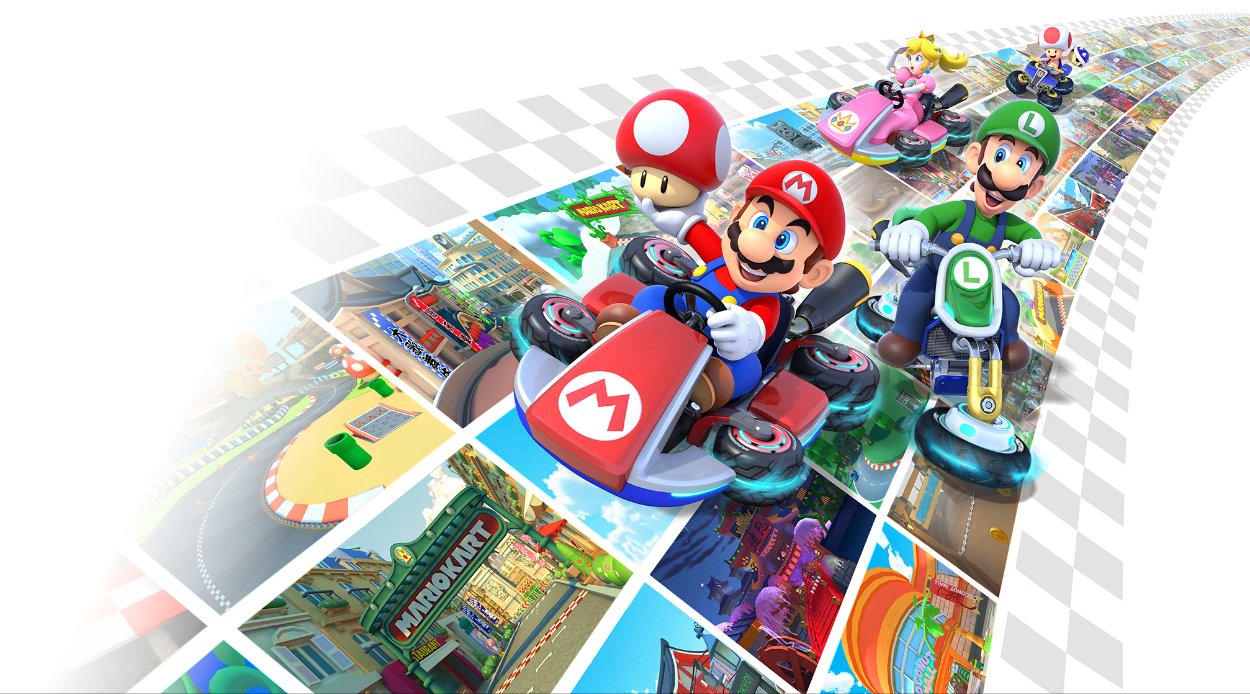
Mario Kart 8 Deluxe: Booster Course Pass (Review)

Booster Course Pass artwork

Mario Kart 8 is quite the extraordinary Nintendo game. In six months it will become ten years old, as it originally was released on the Wii U in May 2014. In its first year it saw several additions of DLC, both paid and free, which is where The Legend of Zelda became part of the fun with the Hyrule Circuit, Link as a driver, and the introduction of the Master Cycle. Including all that, the DLC added 16 new courses at the time, bringing the total to 48, seven new drivers, and 16 kart parts.

In 2017 the game then got ported onto Nintendo's brandnew console, the Nintendo Switch, as Mario Kart 8 Deluxe. This version featured a reworked Battle Mode with eight courses, but also three returning characters (Bowser Jr., Dry Bones, and King Boo), three new characters (the Inklings and Gold Mario), and three new vehicles. The next year then saw the free addition of Link and the Master Cycle Zero from Breath of the Wild, but this looked to be the end of things...

So, it was quite surprising when Nintendo announced the Booster Course Pass in early 2022, offering 48 courses from past Mario Kart games, doubling the total number of cups and courses in the game. In its second half it then also added eight more drivers and 17 Mii racing suits, giving you even more value than what was initially advertised.

start of Wii Mushroom Gorge, promotional screenshot

To say that the Booster Course Pass isn't worth its money would be totally ridiculous. For what's less than half of the base game's price you're effectively getting a whole new Mario Kart game, which uses Mario Kart 8 Deluxe as its foundation. You can also acquire access to all its content via the Nintendo Switch Online Expansion Pack, but that access will be revoked once your subscription runs out. And you can even play the courses without any of this online or in wireless play, as long as one of the other players has the Booster Course Pass or the NSO Expansion Pack. So, it's overall quite generous.

The Booster Course Pass really has turned Mario Kart 8 Deluxe into "Mario Kart 9" at this point, but there is a catch to this: a ninth Mario Kart game already exists with Mario Kart Tour for mobile devices. And it quickly became clear that this is where everything was coming from. With the Booster Course Pass Nintendo has ported over a big chunk of the contents from Mario Kart Tour into Mario Kart 8 Deluxe to create the Mario Kart game of this generation.

This isn't necessarily a bad thing. First of all, the Booster Course Pass wouldn't exist without this particular effort. It's a project that probably co-exists with the development of the next Mario Kart game for the next Nintendo system, where Nintendo is cleverly putting together what they have, in order to offer the fans something "new". And many people don't play Mario Kart Tour, where for them these contents really will be new.

Everything also got fully remastered and this is a great way of preserving what was done for the mobile game, because service games are not forever and there will be a time where you won't be able to play Mario Kart Tour any longer. And even if you play it on a regular basis, the game doesn't let you freely pick courses, since you're bound to the current "tour". So, the ability to play many of these tracks any time you want, on a proper Nintendo console with much prettier graphics, may also be very appealing in any case.

Here's what made it from Mario Kart Tour into Mario Kart 8 Deluxe at the end:

It's quite the list and there should be something in there for every generation of Mario Kart fans, though some get treated better than others. Fans of Mario Kart Wii will find HALF of the game's original courses in here, bringing the total up to 11, where this was clearly favored over everything else. Each wave came with at least one Wii course and four of the other retro courses were also present in the Wii title. It was the big console Mario Kart before Mario Kart 8 and also very popular, so it's understandable to a degree, but they could have swapped one or two of its courses in favor of the something else for a better balance.

The biggest losers are Super Mario Kart and Mario Kart 64 with only two courses each. At least SNES Bowser Castle 3 and N64 Kalimari Desert are very impressive with their changes, but it can't make up for the fact that they didn't really care too much about the originals, which isn't true for Mario Kart Tour. It had a lot more to offer from these games and even a variety of remixed courses of the SNES classic, but it wasn't meant to be.

DS Waluigi Pinball promotional screenshot

Mario Kart: Double Dash!! and Mario Kart DS both got a bit more with three courses each, where GCN DK Mountain, GCN Waluigi Stadium and DS Waluigi Pinball are the highlights. The biggest surprise is probably that DS Airship Fortress didn't make the cut, however, which certainly is a huge fan favorite. But they also had other good options, like GCN Mushroom Bridge, GCN Dino Dino Jungle, or DS Luigi's Mansion...

Mario Kart: Super Circuit was the secret star with five courses to its name, where each wave came with one except for the last. A lot of love was put into remaking these courses in Mario Kart Tour, making them more three-dimensional by adding some height. It's not entirely on par with GBA Cheese Land and GBA Ribbon Road from the original Wii U DLC, but it's still quite nice for some enjoyable short courses. Though, it's a shame that they couldn't preserve the sunset in GBA Sunset Wilds for some reason (it's there in Tour), where this course probably should have been swapped with something else.

Next in the ranking is Mario Kart 7. Now, while there are only four of its original courses present, seven of its retro courses can be found in the Booster Course Pass as well, where it has profited from the Wii hype quite a lot. In fact, all four of its retro Wii courses are there. Mario Kart 7 was seemingly used as a basis for Mario Kart Tour, so many of the new versions of the courses feature elements from that game, like the added underwater section in GCN Daisy Cruiser or the blue glider mushroom in Wii Mushroom Gorge. With this in mind, it's actually surprising that the Nintendo 3DS title didn't even see more additions, e.g. 3DS Shy Guy Bazaar, 3DS Wario Shipyard, or more of its fantastic retro courses, like the aforementioned DS Airship Fortress.

But the biggest chunk of the Booster Course Pass comes from Mario Kart Tour itself. 20 of the 48 courses are from that game, whether they are labeled as "Tour" or as completely new. The "Tour" label was reserved exclusively for the city tour tracks, where each cup starts with one and two also end on one, for a total of 14.

Berlin Byways promotional screenshot

This features cities from all over the real world, where Europe is the Mario Kart Wii of continents, meaning that half of the cities are from there. Curiously, they didn't add anything from Africa or South America, where Cairo and Rio de Janeiro seem like the most obvious candidates. But the development of Mario Kart Tour came to an end, so we will most likely never see these cities in Mario Kart, unless the game gets a successor in the future.

With the city courses also comes the big new mechanic of the Booster Course Pass: re-routing. Each city has at least three different variants in Mario Kart Tour, where they share the same map, but take different routes through that map. For Mario Kart 8 Deluxe these variants were all merged into one course, where for each lap it directs you onto a different route with the help of the new arrow fields. It's a cheap solution and makes it easy to get out-of-bounds on certain ends, but it enables an experience that is entirely unique to Mario Kart 8 Deluxe.

It's technically similar to the sectioned courses, like Mount Wario or the N64 Rainbow Road, but you may drive through certain roads twice or even in reverse, which then lets you potentially run into incoming traffic of other racers. As a result, every lap is entirely unique, where you get a lot more out of these courses from the Booster Course Pass. But it can also make them confusing and very hard to learn, where going into them for the first time can be a mess.

Piranha Plant Cove, which is one of the remaining new courses, also makes use of this mechanic, but the rest are more straight-forward. It's questionable why these six courses are labeled as "new", since most of them originated from Mario Kart Tour as well. Well, two got into Mario Kart 8 Deluxe first, briefly before they also appeared in Tour, but in the end everything was first and foremost made for the mobile game. There are some very simple seasonal courses here, with Sky-High Sundae and Merry Mountain, but also some absolute highlights, like Yoshi's Island, which was based on the beloved SNES game...

Baby Mario, Birdo and Yoshi at the start of Yoshi's Island, promotional screenshot

However, one of the original courses from Mario Kart Tour went missing, which is Piranha Plant Pipeline. We can only speculate why it didn't make the cut, but it's rather odd that they left out a single course in the end, out of 21. It's the most glaring omission in all of this and it only has been playable in Mario Kart Tour once so far, making this a rarity.

Overall, the selection of courses is a mixed bag. There is a lot from Mario Kart Tour and Mario Kart Wii in there, whether you want it or not. We got two more Rainbow Roads for a total of five and four more circuit tracks, where there is now a circuit from every Mario Kart game in Mario Kart 8 Deluxe. Meanwhile there are only two Bowser Castles in the game, but at least there is one more now and an excellent one at that.

Waluigi and Daisy saw quite some love in the course selection to make up for the fact that they didn't have anything to their names in the base game. And meanwhile Luigi still hasn't gotten a single race course in the entire game... At least he was one of the few battle courses with GCN Luigi's Mansion, where there have been no additions to that mode, sadly, even though Mario Kart Tour offers a few battle courses of its own. It may not be the greatest selection, but considering that the new Battle Mode was the big selling point of Mario Kart 8 Deluxe initially, it's a shame that we didn't even get one of them.

Quality-wise the courses are also a mixed bag. The visual difference between the base game and the DLC courses was absolutely jarring in the beginning, where courses like DS Shroom Ridge looked like the were directly ripped from Mario Kart Tour and recycled old course elements, like the ever-same vehicles from N64 Toad's Turnpike. There was also an apparent lack of anti-gravity and underwater sections.

But by now the Booster Course Pass offers some of the best-looking courses in the entire game, like the 3DS and Wii Rainbow Roads, and introduced many new track elements, like the half-pipes from Mario Mart Wii, the Bob-omb cars, giant Wigglers, penguins, and more. And there are some courses that make excellent usage of the underwater and anti-gravity driving modes in the DLC. You can really see how the team behind the Booster Course Pass has learned and evolved over the past two years, potentially even taking the early feedback into the heart.


Drivers and Mii Racing Suits

Part of that early feedback could also have been the lack of any other additions, where Mario Kart Tour has a lot more to offer than just courses. We don't know whether this was planned from the beginning or not, but they certainly didn't advertise that they were also going to add more characters before the fourth wave in 2023. And in the end we got eight in total:

  • Birdo
  • Petey Piranha
  • Wiggler
  • Kamek
  • Peachette
  • Diddy Kong
  • Funky Kong
  • Pauline

Out of the many, many characters present in Mario Kart Tour, they have prioritized the ones from past Mario Kart games. We finally got Diddy Kong and Birdo back, who had appeared in both Mario Kart: Double Dash!! and Mario Kart Wii, but got left out in Mario Kart 8 for some reason, until now. Then there's Petey Piranha from Double Dash!!, Funky Kong from Mario Kart Wii, and Wiggler from Mario Kart 7. And with these additions the roster finally feels very much complete (unless you really are a big fan of R.O.B. or the Honey Queen, but they are not even in Tour).

Funky Kong promotional art on Los Angeles Laps

They've also included some of the new characters in Mario Kart Tour, where Kamek and Pauline were without a doubt the most popular choices... And then there's Peachette, who got in over characters like Dixie Kong, Nabbit, or King Bob-omb.

It's hard to complain about something that is essentially a bonus, but in the end it would have been better if Nintendo had planned this from the start and maybe charged a little more for the Booster Course Pass. With more time and money we could have potentially gotten more of the characters, leaving little to desire. But for the most part they went with the best possible choices.

The new Mii racing suits leave a similar picture. It was a big surprise addition coming with the last wave and they've added a total of 17, all from Mario Kart Tour. These costumes are quite creative, have their own trick animations, and really make the Mii racers a lot more fun to use, where it's fantastic that Nintendo has added these on top as well. But there is a lot more left where they came from and this could have been distributed evenly over all waves right from the start.

And one area that the Booster Course Pass didn't touch at all are the karts and gliders. There are over 700 vehicle parts in Mario Kart Tour, lots of them from past Mario Kart games, and they didn't add a single one to Mario Kart 8 Deluxe during all this effort. It may have to do with the fact that karts and tires aren't separate any longer in Mario Kart Tour, but it's still so similar to Mario Kart 7 that there could have been a way around this...


Conclusion

If you enjoy Mario Kart 8 Deluxe, then the Booster Course Pass is without a must-have, adding a whole Mario Kart game's worth of content on top of what is already there. For this they have ported and remastered the contents from Mario Kart Tour, leaving a mixed bag, both in variety and quality. But overall it's all nice to have in Mario Kart 8 Deluxe, adding a ton of value to the game.

The biggest complaint about the Booster Course Pass is that they didn't go all-in with this, because there are lot of good courses, drivers, Mii suits, and other contents left in Mario Kart Tour, which feels like a waste. But these complaints would become void if Nintendo were to announce more of this DLC in the (near) future.