This review was originally published on ZeldaChronicles (formerly known as ZeldaEurope) and got translated for this blog in 2021 by the same author.
Today is the day and The Legend of Zelda: A Link Between Worlds is finally available in stores. Thanks to a review copy from Nintendo, this site already had the chance to thoroughly vet the game, where it was played for over 50 hours and got completed both in the normal mode and Hero Mode.
The review will be quite thorough and split into different categories that are of importance to a Zelda game. It will also be free of spoilers, where it will only go over the basic story and not reveal any puzzles, bosses or locations of secret items.
The Legend Returns
– A Succession to the Past
It's been over 20 years that The Legend of Zelda: A Link to the Past got released for the Super Nintendo, where it's been the entry into the Zelda series for many fans to date. It's the game that formed Zelda to what it is today in many ways. Cutting grass, opening treasure chests, dashing into trees, putting fairies into bottles – all of these gameplay elements got introduced in A Link to the Past.
It's also a title that has created many fond memories for people, may it be from their childhoods or simply as a special gaming experience in their past. And it's exactly this nostalgia that Nintendo is building on with their newest title, The Legend of Zelda: A Link Between Worlds.
While Link's Awakening on the GameBoy was a sequel to A Link to the Past and Four Swords Adventures took almost everything from the game to create a multi-player adventure, A Link Between Worlds is the first Zelda title that really tries to follow in the SNES classic's footsteps. And that's a big pair of shoes to fill.
A Link to the Past is to many still one of the best entries in the series. It offers a brimming world with lots of freedom and a nearly perfect difficulty, which keeps challenging you without frustrating you. It's in many ways the complete opposite to modern Zelda games like Skyward Sword, which are characterized by high linearity, lots of cutscenes, pushy guides and a lower difficulty.
So, the real question for this review is: does A Link Between Worlds only look like A Link to the Past or is it truly like A Link to the Past...? Does the game return to the quality of the Zelda classics or does Nintendo only offer a pair of nostalgia goggles?
A Tale of Two Worlds
– Story & Characters
Like in A Link to the Past, you can watch some sort of prologue, if you wait a little bit on the game's title screen. This gets told in wonderfully animated artworks and depicts events that will feel familiar from past Zelda games, but are slightly different in the details.
So, while the game should take place after the events of A Link to the Past, it's not 100% accurate. But this is hardly a point of criticism, because this way A Link Between Worlds should be some new fodder for timeline conversations among Zelda fans, while Nintendo also tells the story that works best for the game, instead of keeping things strict to the timeline of Hyrule Historia.
And the story works actually quite well for this game. It's all about the kingdom "Lorule", which is very reminiscent of the Dark World from A Link to the Past, but has its own history and people, who are the mirror images from the people of Hyrule. The naming might strike you as odd overall and the story isn't really that complex, even for Zelda standards, but there are still some good new ideas in A Link Between Worlds, which expand the Zelda universe quite a bit and have a lot of potential – potential that doesn't get fully tapped with this game, however.
Among the new characters is the androgynous antagonist Yuga, who feels like Ganondorf and Ghirahim had a love child. But he knows how to create some surprises and his ability to turn people into paintings is what gives A Link Between Worlds its personal touch, making it disctinct from other Zelda games.
The star of the game, however, would be Ravio, the ominous figure in a rabbit costume, who sells Link his items this time. Even though his greed will remind you of a certain someone from the Zelda series, Ravio was created with a lot of charm and humor, so that he should create fonder memories among the Zelda fans than Tingle did in the past.
The overall story structure of the game is very similar to A Link the Past and Ocarina of Time, where fans of the series should know exactly what they're getting into. Mainly this means that there are only three points in the game where the story really advances. But the story also doesn't get in the way, where its cutscenes kick in just in the right moments, like after a tough boss battle. You can also skip them, if you don't care or have already seen them.
If you want a cinematic story with a lot of cutscenes and lots of character interaction, like previously in Skyward Sword, then A Link Between Worlds isn't really for you. It has certainly more to offer than A Link to the Past did on that front, where especially the characters are more fleshed out and there is more to learn while exploring, but for the most part this game follows the simplicity of the Zelda classics and handheld titles.
A View into the Depth
– Graphics & 3D Effects
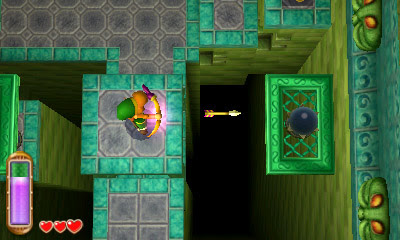
When Nintendo announced that the first exclusive Zelda game for the Nintendo 3DS will be played from a top-down perspective, instead of the 3rd person view from Ocarina of Time 3D, this might have raised some questions among fans. On first glance it doesn't make much sense to use the 3D effect for what's effectively a 2D Zelda game, but once you're looking down on multiple floors of a dungeon, fully perceiving its depths, then you'll realize that this was the perfect choice for the Nintendo 3DS after all.
You're basically holding the game world in your hands, observing it from above, where you finally get a real feel for how high the Tower of Hera is or how deep the waters inside the Swamp Palace are. You can even still see the enemies down in the deep, how they move around. And it all runs so fluidly in 60 frames per second, where it's quite the sight to behold. The game rarely ever stutters and while you might not like the 3D in certain other Nintendo 3DS titles, A Link Between Worlds is a true feast for the eyes, which you should experience for yourself at least once.

But even without the active 3D effect the game looks quite well. Camera and visuals were carefully adjusted to support the depth perception, where you'll also get a good understanding of everything in 2D. There are no optical illusions like in Super Mario 3D Land, so if you only have a Nintendo 2DS or simply can't use the 3D effect, then you'll still get a visually pleasing game. But keep in mind that it truly shines with the 3D on.
The graphics are relatively simple otherwise. While everything gets now fully rendered in 3D, it still follows the simplicity of the SNES predecessor, even to a fault. The best example for this are the dungeons, which look so slick and clean that it seems like Yuga's henchmen scrub these places all day long, so that you can eat from the floors. It's doesn't necessarily look bad, however, and this also goes hand in hand with Link's new main ability, where we'll get to that.
But things are even stranger outside. To achieve the same camera angle as on the overworld in A Link to the Past, certain objects and even persons (including Link) got actually angled, which looks very weird when you're able to view these things from up close. A good example are the statues around the swamp area. You can still see their "faces" from above, just like in A Link to the Past, but these statues actually have the shape of rhomboid in order to achieve this... And this is so odd that it's questionable why Nintendo simply didn't go with a different camera angle here.
An area that got lots of attention to detail are the animations. When an enemy attacks from above, Link will actually look up. When Link walks through grass, it moves with him. All of Links items have been modeled in 3D, where you can even see him eating the apples that you can get from trees for the first time since A Link to the Past. And like in Ocarina of Time 3D, there are a lot of details to be found inside the houses, even a few easter eggs.
New, Old Tones
– Music & Sounds
The game doesn't just put on the nostalgia goggles, but also the nostalgia earphones: A Link Between Worlds is reminiscent of A Link to the Past both visually and acoustically. Whether you collect a Rupee or swing your sword, the remastered sounds will put you back on the Super Nintendo. (And also on the Wii for a bit, because a couple of sound effects have been taken from Skyward Sword.) But amongst all the familiar tones there are also some new ones, where for example the melody when saving at one of the Weather Vanes is especially lovely.
The real nostalgia comes from the music, however, where a majority of the songs from A Link to the Past make a return here in never before heard quality. But Nintendo didn't leave it at one new interpretation, where the overworld melodies keep changing throughout the game. The further you progress in the story, the more epic and orchestral these soundtracks become, inviting you to hum along.
There is also a variety of new songs to be found, where they try their best not to get lost in the shuffle of classic Zelda tunes. Noteworthy are certainly the new melodies for the main characters, as well as the songs for the dungeons in Lorule, where each one now has its own, unlike in A Link to the Past. Some of those are more ambient, others are real earworms, but what's interesting here is that all the dungeons in Lorule are based on the same tune, which itself is based on the classic dungeon music from the first The Legend of Zelda title. This tune got re-arranged in very different ways, always fitting of the dungeon it's played in, which is quite ingenious.
The Adventure in Your Hands
– Controls & Interface
After controlling Link via the touchscreen during his Nintendo DS adventures, A Link Between Worlds offers more traditional controls again. You use the slide pad of the Nintendo 3DS to move around, which provides a high amount precision to navigate around foes and swing your sword in all directions. The items, however, don't offer the same level of freedom, where they get used in eight basic directions. This can be of advantage, because this makes it easier to tell where your shots will go, but sometimes you still might prefer the full 360° freedom, like with the bow in Phantom Hourglass and Spirit Tracks.
Otherwise the controls utilize the buttons of the Nintendo 3DS in familiar fashion. The A button is used for actions, the B button will swing your sword, the L button makes you dash with the Pegasus Boots and the R button lets you hold your shield. X and Y are reserved for other items, which can be assigned freely to those buttons.
The item menu is really well made in this case, probably even the best item menu in a Zelda game yet. It generally works like you would expect it from the static item selections, like for example in The Minish Cap, where it pauses the game and you can re-assign your items using the buttons. But you can also use the touchscreen for this and even freely re-arrange the 20 item slots in any way you see fit.
In addition there is a quick selection for the items, where you can swap them directly via the touchscreen during the gameplay. You can even restrict what items may appear in this selection by setting an area from right to left. This seems quite practical, but in reality it's usually better to just change the items via the menu, while the game is paused.
Sadly, unlike in the Nintendo DS Zelda games, you can't freely make notes on the map. But there are 20 pins, which you can put on the map in three different colors, which is enough to mark any spots of interest for later. The maps are also very detailed, where everything of importance is already visible on them right from the start, without the need of unlocking or uncovering anything. This is even true for the dungeons, where in this game you'll only need to find the Compass to also add treasure chests, keys and locked doors to the map.
A Link to the Wall
– Link's Newest Ability
It's no secret that new Zelda games tend to have a special gimmick, which ultimately makes them unique within the series and which also alters the gameplay in various ways. Whether it's turning into a wolf or riding on a train, you usually know that this will be the one time thing that defines these Zelda games, where these features never return, at least not in the same capacity.
And while this will probably also be true for Link's new "wall merge" ability, where he turns into a living mural that can move around horizontally, you'd wish that this were to become a new staple for the franchise. Much like Link's ability to become tiny in The Minish Cap, this feels quite bizarre, but it's a very natural extension of the classic 2D Zelda gameplay.
Where there's a wall, there's a way. You can use this to cross abysses, to go through irons bars or to dodge enemies and traps. There are use cases for this ability in many scenarios, where fans of classic 2D Zelda will have to adjust to this at first. You might even get stuck early on, because you're forgetting about this new way of traversing the environments, where you literally need to think outside the box sometimes. Where there's a wall, there's a way.
This also offers new perspectives, because the camera follows the wall-merged Link around. Usually you'll be looking at a wall then, but it also gives you the opportunity to take a closer look at certain things in the environments, like the aforementioned rhomboid statues in the swapm or the furniture inside houses. You can even zoom in on people, which never would have been possible in previous top-down Zelda titles and makes you wish always had the ability to switch into first person view to look freely around, like in the 3D Zelda games.
Merging with a wall simply works by pressing A when standing next to it, so you don't need to assign any item for this and can easily use this at any time, where applicable. And the game makes use of this ability wherever it can, where every dungeon was designed with the wall merge in mind. After a while you might even expect that any puzzle can be solved with it and sometimes the game makes things a little bit too obvious, for example by marking paths on the walls with drawn Rupees or Hearts, which can be collected as a mural.
But overall it's hard to imagine another top-down Zelda without this ability, since it just works so well in combination with the traditional Zelda gameplay. A possible sequel to A Link Between Worlds might even use this again, where there's still some untapped potential here. For example you can't use sword or shield as mural to fight enemy murals, which could have been interesting...
Unlimited Bombs & Arrows
– The Energy Gauge
Link's new wall merge ability can't be used forever, however, where it's tied to the new, purple Energy Gauge, which will remind you of the Magic Meter from past Zelda titles, like A Link to the Past. But unlike those, the Energy Gauge refills itself automatically, where it acts as a cooldown mechanic. Once it's emptied, you either have to wait for it to refill or pick up one of the Energy Potions, which you can occasionally find in the environment. Waiting for it to refill can be a little bit annoying, but unless you completely drain the bar, it will regenerate relatively quickly.
It's not only Link's mural form that makes use of the Energy Gauge, but a majority of the items as well. So, shooting an arrow with the bow or throwing your boomerang will consume a part of that "energy", which is a completely new system for a Zelda game and one that works rather well.
It feels great that you don't have to worry any longer about how much magic, bombs and arrows you have left. You don't have to scoop through the environment for potential refills, in case you're out of ammo. You don't have to use the corresponding items sparingly, where you're a lot more motivated to use your entire arsenal instead of just sword and shield all the time.
But at the same time it doesn't necessarily make the game any easier. With the cooldown in place you can't just spam items any longer, where stronger attacks also will drain the Energy Gauge more. So, you have to time you shots more carefully to always have enough energy left for when you need it.
So, overall the Energy Gauge makes the usage of items more convenient and strategic at the same time, where this could be interesting for the future. The multiplayer Zelda titles come to mind here, where previously you could keep spamming arrows and bombs without limitations in Four Swords and Four Swords Adventures and such a system could be used to balance things out.
Also, while they are quite similar, this is not to be confused with the Stamina Gauge from Skyward Sword, which limits Link's physical stamina. Running with the Pegasus Boots or doing Spin Attacks has no effect on the Energy Gauge in this game.
Fire Rod For Sale
– Ravio's Shop
The Energy Gauge isn't the only innovation when it comes to items. An even bigger change comes with Ravio's Shop, where you can get the majority of this game's items early on, which you usually would find as rewards inside the dungeons. You can at first rent them and later even buy them, where renting is quite cheap and buying items will cost either 800 or 1200 Rupees per item.
If you get a Game Over, all rented items will be removed from your inventory and you'll have to rent them again. Purchased items on the other hand will be yours forever and can also be upgraded, where naturally you want to buy them as early as possible.
However, you don't have worry that grinding for Rupees is necessary for any of this, where you'd be cutting grass for hours or repeating the same mini games over an over again. You'll find enough Rupees in the dungeons and environments early on to rent all items right away and to purchase each item, once you truly need it for your adventures. There are so many Rupees everywhere that you always should have enough, unless you ignore all the treasure chests or keep dying regularly.
It also makes collecting Rupees a lot more fun and meaningful. Past Zelda games didn't always make best use of them, where in A Link Between Worlds Rupees are now a lot more valuable thanks to Ravio's Shop.
Experienced players also should have no problem to get through the game without being defeated and with rented items only, which don't require as many Rupees. (But you might want to buy the items in any case for their upgrades.), So, how you approach this shop is up to each player. You can rent all items at once or only the ones you really need. You can buy the items, but you don't have to. The order in which you buy the items is up to the player as well. There is a lot of freedom here, which can result in very different experiences throughout the game.
However, this takes away from the sense of achievement that you'd normally get from obtaining an item inside a dungeon or elsewhere. Usually there are many spots in a Zelda game where you don't have the corresponding item yet and you need to take mental notes for later. And then finally returning to all these spots with the right item can be super satisfying. The typical backtracking.
Now, in A Link Between Worlds nothing is stopping you from getting said items right away, which is super fun early and lets you explore a ton of things at once, but doesn't feel as rewarding later on. This also affects the dungeons, where most of them are not designed around obstacles, where you first need to find an item to overcome them, since you already need the main item to enter the dungeon in the first place.
This doesn't mean that there are no new items to find in dungeons, however. All of the dungeons in Lorule offer a hidden item as a reward, but most of these simply make Link stronger and therefore are optional, while only a few of them will let you progress in traditional fashion. The second case is simply now the exception, instead of the rule, like in previous Zelda titles.
While the concept of Ravio's Shop is certainly a lot of fun for a change, where it can feel very powerful to get all the items right away and use them on enemies, it doesn't feel like something that will prevail in the future. It seems to be more of an experiment in order to bring back more freedom into Zelda, but it's not like giving the player all items from the start was truly necessary to achieve this.
The Hero's New Weapons
– The Items
After discussing how items are obtained and used in A Link Between Worlds, let's also talk about what items there are, where Link's inventory is actually quite superb in this game and leaves little to desire. There aren't many new items, however, where the core relies on classics like the bombs, boomerang, bow, hammer and Hookshot.
What's really exciting here are the aforementioned upgrades, where most of your X and Y button items can be upgraded, similar to Four Swords Adventures. And this is quite extraordinary for a Zelda game. The "Nice Bow" for example lets you shoot a spread of three arrows at once, while the "Nice Boomerang" lets you throw three Boomerangs one after another, all in different directions. The upgrades are all optional, but they are so good that you certainly want them whenever you need a certain item for a dungeon or a challenge.
The upgrades aren't limited to the items from Ravio's Shop, however, where the majority of Link's items and gear can be upgraded in different ways. This is actually the first Zelda game since Oracle of Ages & Seasons, where you have optional upgrades for your sword to counter the stronger foes in Lorule, which feels really good. Ever since The Wind Waker upgrades to your sword have mostly been part of the story progression, where this got quite boring by now... And it's nice to see Zelda returning to its roots here.
The real star of Link's arsenal are the four elemental rods, however, which all offer a much more vertical usage than Link's rods in the past for some impressive 3D effects. The Fire Rod for example creates a flame pillar, while the Tornado Rod will propel you up and damage enemies around you.
The Bug-Catching Net from A Link to the Past returns as well and lets you catch more than just bees and fairies this time: apples and recovery hearts can now be put into a Bottle as well. There are a handful of those in the game and can also be used for different-colored Potions, which are created from monster parts in the same color.
Drinking the Yellow Potion will drain your Energy Gauge and make you invulnerable during this, while the Purple Potion will unleash a powerful strike around you. These potions seemingly replace the Cane of Byrna and the Medallions from A Link to the Past, which certainly would have been too overpowered in combination with the new Energy Gauge. You also need blue monster parts, the Monster Tails, to create Blue Potions, where you might not have enough for them all the time and then have to resort to Red Potions, which will only refill eight hearts, instead of all of them...
The three different monster parts seem like the most underdeveloped part of this. You can get them from monsters and also the environment, but what color drops is entirely random. So, this isn't like the spoils in The Wind Waker or the treasures in Skyward Sword, where you can defeat certain monsters to obtain specific materials. On the other hand it's not really a big deal in this case, since there are only three of these monster parts in A Link Between Worlds anyway, but at the same time this feels highly unnecessary and the potions could have been simply limited by Rupees alone.
Next to the potions there are also two types of fruits, the Scoot Fruit and the Foul Fruit. The former lets you teleport out of a dungeon, similar to the Magic Mirror in A Link Between Worlds, and the latter stuns nearby enemies, which again is similar to the Medaillons. It's kind of weird to have a teleport function behind a consumable item and the Foul Fruit feels kind of unnecessary with all the options that you get from the items anyway, so these fruits feel like the odd part of the inventory.
Otherwise there is a cool, new piece of gear related to bees, but for the most part the selection of items in A Link Between Worlds is very basic, so don't expect anything out of the ordinary.
The Journey is the Reward
– Game World & Flow
Normally every new Zelda game comes with a new world, where even the land of Hyrule looks very different between the different Zelda titles. But now Nintendo takes you back to one of the previous worlds, specifically the Hyrule from A Link to the Past, where you'll be revisiting this land for the first time... (Or the second time, if you've played Ancient Stone Tablets, one of the Satellaview titles, which were a thing in the 90s in Japan.)
In any case it feels like returning to an old home after a long time. It all seems familiar, but there are also many new things to discover. And revisiting all these places is certainly not boring, where the Hyrule of A Link to the Past is still one of the best overworlds in the Zelda series 20 years later, mainly because it's so inviting and open.
Like in the Super Nintendo original, you get a lot of freedom early on, where you can explore to your heart's content. A Link Between Worlds truly is a Zelda game that is all about exploration and discoveries. No artificial barriers are holding you back or guiding you to the next goal. Instead you're picking the next goal yourself most of them time.
And this is certainly a breath of fresh air after ten years of Zelda games that have gotten more and more linear. If you're normally enjoying more open exploration, then titles like Twilight Princess or Skyward Sword could leave you with the feeling of playing a 50 hour tutorial, where the real game never gets started. You were guided from one place to the next, without really exploring the world on your own.
But no more in A Link Between Worlds – the world is open and there is something to find in every corner. And since you can get most major items early on in Ravio's shop, there are rarely ever obstacles stopping you in your adventures. You can also play the dungeons of Hyrule and Lorule in almost every order, which was rarely ever possible in a Zelda game.
While making this possible Nintendo also re-discovered that enemies can serve as a sufficient obstacles in the game world. If you're getting into a more difficult part of the game, you'll immediately notice thanks to the stronger foes, which might kill you in a few hits. And in that case it might be a good idea to go somewhere else and become stronger. At the same time this gives experienced players the possibility to take on challenges, where they play the more difficult areas first.
The world of Lorule opens at a similar point as in A Link to the Past, but is actually more different from its Dark World counterpart. For example there is no Pyramid of Power here, where instead Lorule Castle is waiting at the center of the map above a huge chasm, which divides the lands of Lorule into seven different areas.
After the segregated overworld sections in Skyward Sword and the Nintendo DS Zelda games weren't to everyone's liking, this was probably not the best choice. The idea is that you explore Hyrule for portals that lead into the corresponding areas of Lorule, but there are so many of them that they just could have connected some of the areas in Lorule as well for the sake of convenience.
In the least it's not a problem to quickly get from A to B in A Link Between Worlds, which is quite nice after the rather cumbersome train and bird rides in the previous main titles. There are a lot of Weather Vanes to find all around Hyrule and Lorule. And once they got activated, you can use them to save your game and as teleportation points. Sadly, you can't save everywhere and at any time, which is probably due to the fact that there's some potential punishment on a Game Over. But since you can teleport to the Weather Vanes, it's not really an issue, in case you quickly want to save.
Palaces Between Worlds
– The Dungeons
A Link Between Worlds offers the same number of dungeons as A Link to the Past, which is an achievement by itself, because these two Zelda games are the record holder when it comes to this number. So, the dungeons are an important part of the game and you'll spent a lot of time in them, where it's probably good news that they usually only share the name and the overall theme with their A Link to the Past counterparts. While you'll return to the Eastern Palace and the Tower of Hera, which are still found in the same places, the insides of the dungeons are completely new.
What's also new is that you tackle the dungeons in almost any order. In Hyrule you can choose between the Tower of Hera and the completely new House of Gales early on. And in Lorule seven dungeons are waiting for you, where only one of them needs an item from one of the others, so you can enter it. While the Dark World in A Link to the Past offered similar freedoms, it was certainly not on the same level.
In fact there are 5040 possible orders of beating the dungeons in A Link Between Worlds and "only" 66 in A Link to the Past, making this the least linear Zelda game to date, which again is quite the achievement. (The first The Legend of Zelda is second with 672 different dungeon orders.)
Now, with no clear order in the dungeons there is also no clear difficulty curve, where some of the dungeons are about even, while there is at least one dungeon that really stands out by being more challenging than the rest. The items in Ravio's shop, which are needed to enter the respective dungeon, already give you a good idea based on their pricing and availability. And as described earlier, the overworld areas can already be an indicator for how difficult the corresponding dungeon might be...
But the game let's you do as you please, where you might even go for the most difficult dungeon first. This will give you a proper and thrilling challenge, which is on par with the tough dungeons in A Link to the Past, but then you'll be very disappointed with the rest of them, which are way too easy in comparison.
And this leads us to the main point of criticism about A Link Between Worlds: the dungeons aren't dangerous enough. Especially when compared to their counterparts in A Link to the Past, the dungeons simply don't come with the same number of strong enemies and traps to keep you on your toes.
The best example is the Eastern Palace, which had multiple Eyegores in the original – tough statues that can only be attacked when they open their eyes. In A Link Between Worlds the same dungeon has none of them and these enemies are super rare in the early game. Sometimes the game even treats these stronger foes as mini bosses... This is in stark contrast to the overworld, which is about as deadly as it used to be in A Link to the Past, even deadlier in certain areas, where it's weird that Nintendo toned the dungeons down so much.
Otherwise the dungeons are pretty great. Not only can you play them in any order, some of them are also quite non-linear themselves, which is a good development. Ever since The Wind Waker Nintendo put a lot of focus on creating a clear flow through the dungeons, which completely annihilated any challenge that came from navigating the labyrinths of older Zelda games. While the dungeons of A Link Between Worlds are certainly not the most complex of mazes, they at least offer some choices of where to go next here and there, which is better than having completely linear dungeons all the time.
Some of them are still totally linear, like the Tower of Hera, but it's really about having a good mix of different types of dungeons with different layouts and flows. And A Link Between Worlds offers just that, as well as a good mix of different ideas.
The Dark Palace is now true to its name and only lets you see certain things in the dark. The Swamp Palace has now sophisticated mechanics to alter its water levels, where this looks quite gorgeous with the 3D on. (Don't worry, this is more fun than in the Water Temple in Ocarina of Time.) The dungeons in A Link to the Past already had some unique ideas to them, where some of it even returns in A Link Between Worlds, but it's all a lot more developed in the Nintendo 3DS game.
The only exception to this would be the Skull Woods, which doesn't have as many entrances any longer and where the dungeon itself is a lot more linear. But instead it makes use of its Wallmasters for some creative new puzzle ideas...
Speaking of, the puzzles are actually quite excellent, where they not only utilize Link's wall merge ability whenever they can, but also incorporate enemies or traps in clever ways. The game has some really good brain teasers waiting for you, especially if you want to get to all the optional chests with new items in them.
The biggest difference to your usual Zelda cost is of course that you already enter the dungeons with their corresponding main item equipped, instead of obtaining it there. There is an exception to this, but the majority of dungeons follow this new concept. And while it takes away from the usual achievement of finally getting the "key" that changes everything in a dungeon, the items get used right from the start and more extensively for much better puzzles.
You also don't have to worry about going into a dungeon without the right item, where you may miss something right in the middle. (If you're tried to clear the Water Temple in Ocarina of Time without getting the Fairy Bow first, you know the pain.) That's because you won't even be able to get into the dungeon without the item(s) you need and just to make sure the dungeons are also marked with pillars that show you the exact requirements.
However, usually you only ever need one item for one dungeon, where this simplifies things quite a lot and also doesn't allow for clever combinations of items, which is a shame. The game does have a series of mini dungeons, though, where some of them make use of two items at once in smart ways, which is quite excellent, but also shows how much wasted potential there is with the current system.
So, while the concept of getting the items first has its merits, it also does have its drawbacks and wasn't fully developed in A Link Between Worlds, where its future in the series remains questionable for now.
Sword Fodder
– Enemies & Bosses
While the game does have a couple of new enemies, the majority of them returns from A Link to the Past. They all got modeled in 3D with great care, where some of it looks really adorable in the miniature worlds, for example when the evil soldiers land on their backs after being defeated.
The fighting has improved quite significantly over A Link to the Past, since you're not just getting swarmed by killer sprites all the time. It's all a lot more graspable and smoother. That doesn't necessarily mean that the fights are much easier, where for example the soldiers with their lances and bows still pose quite the threat. You also have to shield manually now and certain enemies can now shield themselves, where you need to get around this with the right items.
But enemies can hurt each other this time, which you can use to your advantage. A good example are the mighty Hinox, the bomb throwing Cyclopses, which are found in many areas of Lorule, where their bombs can hurt other enemies. But they will also hurt you a lot, so better be careful.
However, powerful enemies like this can also be effectively stun-locked by pushing them against an obstacle, like a wall, and quickly mashing your sword... So, this can take away from the overall difficulty of the game at times.
But together with an array of items that can all be used offensively, it's quite fun to run around the worlds of Hyrule and Lorule and fight some monsters, just because you can. And that speaks for itself.
The different bosses can be quite fun as well, where there are some new ones, as well as some familiar faces from the Super Nintendo. The latter have been altered so much, however, that they are basically new boss fights. And some of the new ones are really well executed, where they use your items in very creative ways. The bosses also tank quite a bit, which makes them feel more like proper fights than just glorified "use the right item" puzzles.
Overall the boss fights are so much fun that there is only really one complaint here: the game doesn't have boss rush mode. That's a feature that got introduced in Ocarina of Time 3D and Skyward Sword, where you fight all the bosses one after another. But sadly this doesn't make a return here, where you might want to fight certain bosses again, but you can't, unless you start the game over from the beginning. And that's too bad.
Collect & Upgrade
– The Sidequests
A Link to the Past was the first Zelda game to introduce a more substantial collectible item with the Pieces of Heart, where A Link Between Worlds has a total of 28 (four more than on the Super Nintendo), which are distributed in a similar fashion and are also often won in mini-games. If you enjoy collecting them, then this will be business as usual.
Somewhat more interesting are the Maiamais. These are little snails, where there are a 100 of them hidden all over Hyrule and Lorule in many different ways – beneath bushes, in trees, below rocks... basically everywhere. They do make squeaky sounds, so you can hear it whenever a Maiamai hides in the proximity. It's basically like a mix between the Secret Seashells from Link's Awakening and the Gold Skulltulas from Ocarina of Time, two of the better collecting quests in the Zelda series.
The map will tell you how many Maiamais are still left per area. So, if you're missing only a few of them, you don't have to search for them everywhere. Combined with the fact that they give their positions away with their squeaks and that you can get most items in the early game, this isn't exactly a challenging task. Once you've learned all their usual ways of hiding, it becomes more of a chore and you might collect lots of them at once whenever you enter a new area.
But whether you'll enjoy collecting the little snails or not, it's certainly worth it to bring them back to Mother Maiamai, who rewards you with the upgrades for your items for every ten Maiamais. You can choose which item to upgrade next, but you need to have purchased it at beforehand. As already mentioned, the upgrades are all very powerful and useful, where this is by far one of the most rewarding quest for collectibles in the Zelda series.
Other than the Pieces of Hearts and Maiamais, there aren't many sidequests to find in this game, however. There are a couple of other optional items, like the Bottles, but for the most part the sidequests have about the complexity of the ones in A Link to the Past or the GameBoy Color titles, where finding a message in a bottle is one of the highlights. If you're looking for more sophisticated character interactions, like in Majora's Mask or Skyward Sword, then this title will disappoint you.
In the very least there is no permanently missable items. It's always a pity when you reach the end of a game, only to realize that certain items can't be gotten any longer. Other than a single treasure chest with Rupees (in Rosso's house), nothing can be missed in A Link Between Worlds, which is great and should be praised.
Lots of Cuccos, Monsters and Rupees
– Mini-Games
What goes hand in hand with sidequests are of course a series of mini-games. Of course the classic Treasure Chest Game from A Link to the Past has to be there, where it's called "Fortune's Choice" and comes in two variants: one with two chests in Hyrule and one with twenty chests in Lorule. The latter is more risky than the one in the SNES original, where it's not as easy to score lots of Rupees, but still possible.
But if you want to score Rupees, then the new Rupee Rush game is probably the better choice, which also comes in two versions, one for each world. Here you have a small parcours, where your goal is to collect as many Rupees in 30 seconds as possible. However, you have to stop the game by talking to the owner before the 30 seconds run out. And there is no timer.
This might sound tough, but the courses are well designed for this time limit and you can also use the music as an indicator for some close calls, where your score even gets tripled. So, once you've got the hang of this mini-game, it's actually a very good and fun way of getting lots of Rupees.
One of the many things that A Link to the Past introduced to the Zelda series are Cuccos and their "Revenge Squad", where the raging chickens will attack you from all sides. A Link Between Worlds now turns this into its own mini-game with the Cucco Ranch, where you have to dodge the Cuccos under a timer. It's far from the most fun mini-game ever, but it's good practice for precisely moving around with the slide pad, which might be useful later on...
(Update: there is also an "Endless" variant, which isn't so endless after all. If you manage to survive 999.99 seconds without a single mistake, which is borderline impossible and by far the hardest thing to do in the entire series, you'll get a special reward, which will also be shown during the credits. This makes A Link Between Worlds quite unattractive for 100% completion, sadly.)
And if you don't have enough of running around, there's also the Hyrule Hootfoot game, where you have to get from a point in the southeast of Hyrule to the northwest. Once you got the main reward here, it's probably not that interesting, however, and you can even cheat...
All of these mini-games use the game's normal mechanics, where it's often the mini-games with completely new mechanics that stand out, for better or worse. The Goron Dance in Oracle of Ages or Rollgoal in Twilight Princess would be two of the more controversial examples here.
A Link Between Worlds has one mini-game in that category with the Octoball Derby, which is a lovely, little baseball mini-game, which was charmingly crafted and comes with some good humor and music. It's not exactly easy to get the hang of it, however, where perfect timing is key to shoot the ball in the right direction. But with some practice it's not the worst mini-game ever.
The highlight with all certainty is the Treacherous Tower, however, where you battle through hordes of monsters in a series of chambers. It works similarly to the "Take 'Em All On!" mini-game in Spirit Tracks, but it only re-uses one of the bosses and also offers a version with 50 rooms, which is more like the Savage Labyrinth in The Wind Waker or the Cave of Ordeals in Twilight Princess. So, mainly this is about defeating monsters as efficiently as possible, which is a lot of fun with the multitude of items.
There are highscores to make in every mini-game for some longer entertainment, if you're into this kind of thing, but sadly there are no online lists for highscores, which could have been interesting.
An Adventure for Eternity?
– Length, Difficulty & Replay Value
Beating the game and clearing all sidequests (except for the Endless Cucco Rush challenge) will take around 20 hours, give or take. If you're experienced enough and rushing through the game, this may be less. It's certainly not the longest Zelda game, but it's quite solid for a handheld title.
And how long it might take to complete a game is only one part of the equation. There are also the pacing and the replay value to consider, where A Link Between Worlds shines quite brightly. It's a game that's certainly fun to start over, where the open approach adds to this. You can get the items in Ravio's Shop in a different order, play the dungeons in a different order and take different paths through the world. Each playthrough can offer a different experience.
On the other hand it also doesn't really matter in what order you do things, other than getting certain power-ups earlier than others. It doesn't have any effect on the story or such, where doing things in a different order truly creates something that you couldn't experience otherwise. It's more about what the player makes out of it, but the result in the end will always be the same and there are no game-altering choices of any kind.
In any case, the game is also fun to replay, because of its excellent pacing. After the rather slow paced adventures of Spirit Tracks and Skyward Sword, it's actually very refreshing and satisfying to get a Zelda game that doesn't hold you down in any way. There is no major tutorial of any kind. You're not running from one cutscene to the next. You don't have to participate in any fetch quests to get into the dungeons. There are no virtual hamster wheels to keep you busy. The game is quite pure and it respects your time. Link also moves and attacks fairly quickly, where it's a joy to play through A Link Between Worlds again.
It also respects the player's intelligence much more than certain other Zelda titles. The intrusive guidance of Fi in Skyward Sword was probably the low point here and caused even many memes amongst the community, where Nintendo seemingly has taken note here. Instead of a companion, who tells you what to do on every step, there are now so called Hint Ghosts hidden everywhere. You can only see them with the Hint Glasses, however, and they will only help you, if you're investing the Nintendo 3DS Play Coins into them. It's kind of weird that Nintendo uses this currency instead of the ingame Rupees, since you can only get the Play Coins from moving around with the system and they are usually tied to StreetPass stuff...
But at least it seems like Nintendo wants to encourage the players to try themselves, before they seek guidance. The tips aren't even too shabby, where for example you can learn about any exclusive prizes in mini-games. But if you don't want to be carried by the game in any way, then you'll like the approach of A Link Between Worlds. The next dungeons get marked on the map, but otherwise it's up to you to figure things out, just like in the oldest Zelda games. But if you need help in some form, it's there, just hidden from view without the Hint Glasses. And that's a really good system, which hopefully will be considered for future Zelda titles.
This has also a positive effect on the overall difficulty level. It makes certainly a difference when the game doesn't bombard with hints for every puzzle and when you can simply explore on your own, where overall the game goes more in the direction of A Link to the Past. Enemies are also much more dangerous again, where especially the ones in Lorule can hurt you quite badly for multiple hearts of damage. And that's quite refreshing. However, since the dungeons shy away from using too many or too strong enemies against you, it doesn't really reach the excellent difficulty of the Super Nintendo original and experienced players will probably get through the game without ever getting a Game Over nonetheless.
But this could be different in Hero Mode. You have to unlock this one by beating the game once, where afterwards you can choose between the two modes whenever you start a new game. So, it's not an option, which you can toggle on or off at any time, like in The Wind Waker HD. It's more like a New Game+, where you might even discover something new on your way...
Unlike the Hero Modes in previous titles, you can still find recovery hearts normally, but you'll also take quadruple damage...! This means the minimal damage is always two hearts, where in the early game every mistake can lead to death. Later on enemies will even deal eight hearts of damage at once, where you either need to be good at dodging or bring lots of Blue Potions (ideally both). So, while some players might not like the fact that they have to unlock Hero Mode, it's probably a good idea to normally play through the game at least once in any case, because your knowledge of the game will help a lot with this challenge.
Ideally, Hero Mode had also done something to make the dungeons harder as well, where making more and stronger enemies appear would have already been enough. It's a shame that Nintendo doesn't try to create a proper "Master Quest" any longer, but the quadruple damage Hero Mode should be a worthy challenge in any case.
In addition you can always make challenges of your own. All additional Heart Containers and Pieces can be skipped to play through the game with three hearts only, if you so desire. And with the immense freedom you can even play the toughest dungeons first. A Link Between Worlds is the ideal playground for Zelda fans who are seeking a good challenge.
And if that's not motivation enough to pick up the game again, then maybe the StreetPass functionality of A Link Between Worlds will do the trick for you and keep you busy for a while, even after beating the game. Here you can create and fight Shadow Links, where there will be a separate review just for this feature on this site, after testing it thoroughly on the streets of Berlin.
The Best of Both Worlds
– Conclusion
A Link Between Worlds isn't just A Link to the Past on the surface with some pretty 3D effects added on top, it's a return to the values of the original. Gone is the unnecessary hand-holding, you are freed from the chains of linearity and useful upgrades have returned to the series. A Link Between Worlds makes multiple steps in the right direction. And yes, it does stumble over its own feet somewhat, especially with the item shop system, but it does make up for it with its fresh ideas, great pacing and good replay value.
Fans of the Zelda classics will likely find this to be the best Zelda game since the Nintendo 64. However, in order to achieve this, A Link Between Worlds also copies heavily its Super Nintendo predecessor and relies heavily on this nostalgia, where the game is essentially both a remake and a sequel, a "requel" so to speak. But there is hope that the next, completely new Zelda game will also follow these traditional values in its own ways.
The Good:
- Classic Zelda à la A Link to the Past
- Impressive and stable 3D
- Fantastic Soundtrack
- Open world with lots of freedom
- No hand-holding thanks to hidden hints
- High replay value and great pacing
- Wall Merge ability creates good puzzles and possibilities
- Energy Gauge for items works quite well
- Good number of diverse dungeons with great puzzles
- Fun to fight enemies and bosses
- Worthwhile collectible with the Maiamais
The Neutral:
- Item Shop is a fresh and fun concept, but takes away from the usual achievements
- Hero Mode does quadruple damage, but not much else
The Bad:
- Dungeons could use more enemies overall
- You rarely need multiple items at once
- You can only aim in eight directions
- Mostly simple side quests
- No boss battle mode