Showing posts with label Zelda Manga. Show all posts

Sunday, April 7, 2024

Twilight Princess Manga, Vol. 11


The tenth volume ended with the battle against Dark Beast Ganon, which is Link's last action as a wolf, both in the game and the manga. As a result, the last volume invests a lot of time into the final battle against Ganondorf, something that the other Zelda manga probably would have resolved in a couple of pages...

There was a lot coming together in the volume before, as one epic battle in Hyrule, and only little of that remains in the final volume. You can see Ilia releasing Epona, who then goes to assist Link and Zelda in their battle, which is nice connection, because in the game the horse basically comes out of nowhere. Ilia then gets attacked by some Bokoblin (or whatever), where the manga cuts off, and we later see her next to a dead King Bulblin, who has given his life to defend her and others... Again, this is a good use of this character and also quite the redemption.

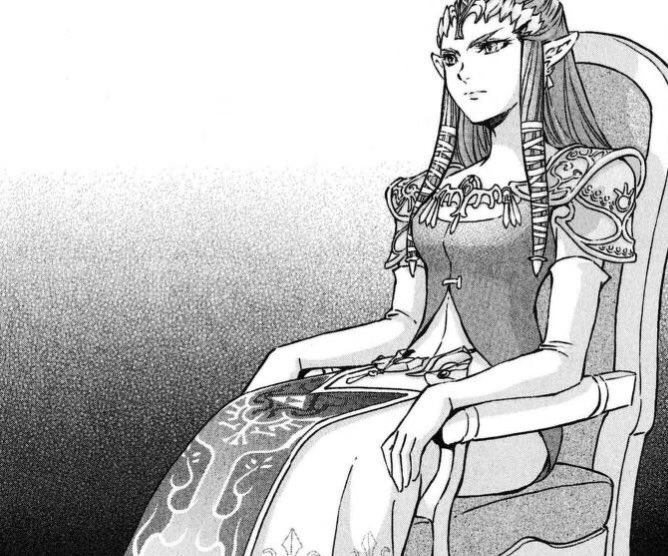
The rest focus almost entirely on Link, Ganondorf, Midna, Zelda, and... the Hero's Spirit. The latter actually joins Link for a chapter during this "duel" with Ganondorf and then has one final moment together with Princess Zelda, who has the memories of the Zelda from Ocarina of Time, re-uniting her with the Hero of Time. It's a very beautiful scene.

Ganondorf gets defeated with the same goofy expression as in the game as he gets pierced by the Master Sword. But the manga leaves out the infamous and creepy neck snap moment with Zant, right before Ganondorf dies for real. This scene has spawned theories and discussions left and right, where Akira Himekawa just dodges it entirely. Well, it never really made that much sense to being with, since Zant was already blown to smithereens by Midna, so I can understand the decision. But it would have been nice if the manga tried to give some explanation.

Instead, it will give you something else to talk about, at least if you're into shipping. Other than Ilia, the game doesn't really dive much into the territory of love interests for Link, but the manga doesn't hold back when it comes to the relationship of Link and Midna. Well, he already kissed her on the cheek in the previous volume and as she is about to leave, he acts like a child, wanting to go with her. So, she first slaps him and then kisses him for real, creating a memorable good-bye moment, worthy of her dominant character. And Link's heart breaks right with the Mirror of Twilight when she departs.

Meanwhile, Ilia is waiting for Link to return, but all she gets is Shad, who has a crush on her in the manga and is looking to score. So, he's in love with someone, who loves another, who loves another, who is out of reach... Typical stuff, but it's more than what you usually get from Zelda games, at least from the later ones. The earlier games had a bit more going on for Link, like with the implied kiss at the end of Zelda II, Marin in Link's Awakening, and even various girls in Ocarina of Time. Today he gets abused by giant, chubby fairies.

Anyway, Link has ran off for adventure, leaving the Master Sword behind. Sadly, the manga doesn't seize the opportunity to show what really happened at the end of Twilight Princess. Link ditched the Master Sword, because he found a much better weapon – the Phantom Crossbow. And the he goes to blow stuff up all over Hyrule! If that's how the manga ended, then it would have been perfect...

Nah, jokes aside, the Twilight Princess manga has too much unnecessary filler for my taste to be perfect. I've really enjoyed the course they've taken with many of the characters, like Zelda and the Hero's Spirit, adding a lot more depth to them. And the overall change of direction, making this more mature and really taking the time to tell the game's story, is so much better than what they've done before. But it could have been at least one volume shorter by cutting out characters and scenarios that aren't from the game.

Still, it's pretty much a masterpiece compared to the earlier manga, and I'd love to see this take on another Zelda game, where the best candidate is probably Skyward Sword. Especially the relationship between Link and Zelda is something that can shine here. Of course, there are the much popular Breath of the Wild and Tears of the Kingdom, but to me the manga always had this "retro" feel to it, where I'd like for them to focus on what's left from the classic Zelda games. A Link Between Worlds would be another candidate, though one for the shorter, less serious style from before, like Four Swords.

In any case, I'm curious to see where Akira Himekawa will lead us next...

Thursday, March 28, 2024

Leipzig Book Fair 2024 Loot


photo of the eleventh Twilight Princess manga and a variety of sticker sheets

Last weekend I've visited the book fair in Leipzig, which is also a "Manga-Comic-Con" at the same time with lots of nerd stuff. It takes up around 25% of the convention, but you will instantly notice how that's the most popular part, with many cosplayers around and such.

Well, here you can see what I took home with me. Nintendo is always present at this convention with a booth and you can get some free My Nintendo merchandise by scanning a QR code. You need to login with your Nintendo account and you will also get 100 Platinum Points, where the mission reads "Completed: Check in at Manga-Comic-Con 2024". But of course you will only be able to do this once, unless you have multiple Nintendo accounts.

Last year they gave away "My Nintendo"-themed pens and tiny ring books. This year it was sticker sheets... The Super Mario sheet was separate, they kept handing this out to people around the booth, but for the Tears of the Kingdom Ganondorf and the Pikmin 4 artwork you had to check in.

I'm not sure if they had other motives, because I was there at the last day of the convention only. Maybe the days before they also had Link and Zelda... But you were getting both stickers twice and as I said you can only do this once. And it's not really important, it's just stickers.

As you can see, the convention was also a reminder for me to finally get the last volume of the Twilight Princess manga. I will share my impressions about it once I've read it.

Sunday, July 31, 2022

Twilight Princess Manga, Vol. 9 & 10

The manga of Twilight Princess almost makes the story of the original game feel like some epic saga, where everything is coming together at the end. Volume 9 dives into the Twilight Realm and shows how Midna and Link fight against Zant. In the manga Zant wants Midna as his wife, which adds some weird undertone to it all, but isn't entirely out of character. The fight still plays out quite similar to the game, with Zant taking different forms and Midna using her powers against him at the end.

What's not in the game at all is Link's backstory, where he once lived in a city near the Arbiter's Grounds. There a sword rests, the "Gaurof Sword", which like the Master Sword could only be pulled by Link, which caused the entire city to disappear into the Twilight Realm. And there they are alive and well, waiting to be found in the second half of the ninth volume for some weird scenes.

It's honestly a lot of filler, where the only purpose is to show that the Twili can be also kindhearted, since they've provided the Hylians with supplies to survive. But the manga could have done without all of this and maybe even ended after ten volumes if it weren't for all the unnecessary additions.

Or it could have focused a little bit more on what was already there in the game. The manga creates new things, while the source material already had similar stuff to work with. For example Impaz and the Hidden Village don't appear in the manga at all, while there was this lost village and the girl in the seventh volume, which feels very similar in tone. I guess that a young girl was simply more interesting than some old woman, but this whole part around Ilia's plot was dropped entirely.

And even though Ilia has some nice additional moments, like the one where she shows some empathy towards King Bulblin in the eighth volume, the characters from Ordon don't really play any role any longer. Instead you have Link's new friends from that desert town that never existed... Well, they are there to fight at Hyrule Castle in the great finale, but there was already the Resistance for that.

But credit where credit is due: the manga really makes it feel like a great finale in its tenth volume. Ganondorf unleashes his army of darkness onto Hyrule, which puts all life at stake. In the game no one really cared what happened, since there was no imminent threat to the people of Hyrule, unlike in Majora's Mask for example. The manga changes this and it even gives a sense of desperation, because the force field around Hyrule Castle prevents the Resistance and the knights of Hyrule from achieving anything. It's only thanks to Midna that they can enter the castle, where they storm it with Link at the forefront. Absolutely epic. And it even manages to let Ashei look cool.

The manga also makes use of King Bulblin's change of heart in all of this, where here he follows the strongest in action, not just in words. It's written quite well and proves that Akira Himekawa can make the most out of what the game has to offer. If they had focused more on that instead of adding whole new plotlines and characters, then the manga would have been much better.

Well, it all ends right in the middle of the final battle, so there is one more volume to go. This hasn't been released in Germany yet, so I will have to wait a couple of months for the conclusion.

Saturday, July 30, 2022

Twilight Princess Manga, Vol. 7 & 8

The seventh volume of the Twilight Princess manga probably contains one of its most memorable scenes: Link climbing a steep mountain wall just like in Breath of the Wild. It's just the best reference they could have done.

No, of course I'm talking about the part in Hyrule Castle, where Ganondorf invites Zelda to a cup of tea and they discuss the events of the child timeline. The Triforce of Wisdom let Zelda "awaken", so she knew of her past incarnations' doing to send the Hero of Time back in time, thus changing the course of history, which led to Ganondorf's execution.

When banished into the Twilight Realm, Ganondorf also became aware of what changed his fate. So, he puts Zelda at a fancy table and asks her what she knows about all of those shenanigans. And it's really nice how the manga dives deeper into the lore created by Hyrule Historia, putting together the events of Ocarina of Time and Twilight Princess.

It also doesn't stop there, where the Hero's Spirit is finally confirmed to be the Hero of Time. There is this amazing scene in the Temple of Time where Link sees the Hero of Time drawing the Master Sword and becoming an adult. You can also see briefly how the previous hero looks as an older man in the first half of the volume, where Link gets nurtured by a girl named Anika in some vacant village, which probably could have been the Hidden Village. But it's somewhat unclear (at least to me) how the Hero of Time made it into the Twilight Realm, where he stood at Midna's side as the golden wolf. So, it feels like a bit of a mess.

At the beginning of the eighth volume the Hero's Spirit then trains the new hero in most of the Hidden Skills, like the Back Slide, the Helm Splitter, and the Mortal Draw. It feels a little bit video-game'ish, but I suppose this came with the territory of a more accurate translation. But it probably could have worked without the Hero's Spirit explaining these techniques in details. Just show them training and then the fruits of that labor.

Anyway, the rest of the eighth volume dealt with the City in the Sky and wasn't as good overall. Midna activates the cannon found under the church in Kakariko Village, which comically blows away the roof, complaining how the people of the Light World can't get anything done themselves. This doesn't sit right, considering how they needed some clown to fix said cannon in the game.

And there is more weird stuff coming ahead, not just the Oocca themsevles. Argorok is actually not a Kargarok mutated by the Mirror Shard, which is a popular fan theory, but some golden dragon deity, which normally protects the City of Sky. Now it does the opposite, where is there is this funny scene with an Oocca stating that over two thirds of the City of the Sky already got destroyed by the dragon.

For Shad, who has joined Link on his travel to the sky city, this is actually a motivation to fight the dragon, because he wants as much of the city to be preserved as possible. During one point of Link's battle against Argorok, where in the manga he also fights an Aeralfos at the same time, he loses the Master Sword and it sticks into the ground. Then Shad comes to save the day, where he is able to quickly pull it out and throw it into the Aeralfos by accident.

Like... okay? Is Shad also a chosen hero now? Can anyone just take the Master Sword as long as it doesn't rest on its usual pedestal? Or maybe this is yet another reference to Breath of the Wild, where even a Moblin can take the Master Sword when it finds its way through the Lost Woods? We will probably never know...

Sunday, July 24, 2022

Twilight Princess Manga, Vol. 5 & 6

photo of all ten volumes of the manga by Tokyopop

Well, since there currently aren't any news about Zelda, I decided to finally complete my collection of the Twilight Princess manga series, where by now ten volumes have been released. It really got up to ten, where Twilight Princess has as many volumes as all previous Zelda manga combined. And that's not even all of it, where the eleventh volume has yet to be released in English or German. Akira Himekawa really must have loved the setting. Anyway, I will still be going through this two volumes at a time, like I did before, because this feels like a good pace.

The fourth volume ended on a cliffhanger with Zant appearing at Lanayru Spring, which was a cool way of ending one of the books. The "Midna's Lament" part then led to the only appearance of Agitha in the manga so far, where her only purpose was to stir up the other townsfolk after seeing Wolf Link. Maybe she isn't as popular with the mangaka(s) as she was with Omega Force.

Otherwise the manga tries to create more connections between the characters, connections that weren't there in the game, e.g. Auru being Zelda's tutor. The biggest of these new connections is probably between Princess Zelda and Princess Midna, who were able to see and speak to each other as children through some magic well inside in Hyrule Castle, which let young Zelda see into the Twilight Realm.

So, Midna and Zelda are childhood friends in this, which feels weird at first, but you can't really blame Akira Himekawa for adding some more relations, because the Zelda in Twilight Princess didn't really have any. This was always an issue of the original game, where Zelda was only there for some cutscenes and the final battle. She always was one of the most dignified versions of the character and also very pretty, but the game just focused on Midna and her story, while it probably should have been a story about two princesses from different realms.

But their friendship in the manga didn't last long, because when Zelda gets spotted using the well, Auru commands it to be closed, because the Hylians see everything in the Twilight Realm as evil. The manga explores both sides of this whole Twilight Realm idea, where from the perspective of the Twili the people in the Light World are bad, because they use to discard anything unwanted into the Twilight Realm. In the game it was really just Ganondorf and this was only an act of desperation, where the Sages wanted to kill him with their sword first, but then had to resort to other means.

But in the manga they use the Mirror of Twilight as a tool of banishing people on a more regular basis, mainly to create some more conflict, where we even get to see the king and how he commands that Ganondorf is to be banned into the Twilight Realm. Hearing about all this, Link is questioning how the gods let Ganondorf have the power of the Triforce and not differentiate between good and evil. It just doesn't make any sense to him and he sounds somewhat entitled, like the Triforce is only something for "pure" people like Princess Zelda and himself.

At least what's identical to the game is that Wolf Link seems to be the only thing the townsfolk of Hyrule worry about. In the manga it's stated that the barrier around Hyrule Castle can only be seen from a close distance to give some sort of explanation, but it's still silly.

Skull Kid first fights Link in the manga, like he did in the game, but he then starts to recognize him as the hero and says that he has been waiting for him for a long time. That's another nice connection here, where hopefully the manga will acknowledge the Hero's Spirit as the Hero of Time later on.

The sixth volume has only two chapters, where the first focuses on Snowpeak. Ashei used to live at Snowpeak Castle, which makes sense following her little back story that se gives you in the game... And this leads to yet another dungeon duo, where Blizzeta summons two Darkhammers, so that both Ashei and Link get to fight with a ball & chain afterwards.

Actually, it would have made the resistance troupe a lot more interesting if they assisted you like that in the game, basically like Medli and Makar before in The Wind Waker. But since nobody was ever supposed to see how Link can transform into a wolf, this would have been more of a hindrance, which is even a dilemma for Link in the manga.

But I have to say that I like some of the ideas presented here. Usually, I'm not a big of fan of what the manga try to add to the story and that's still true with Twilight Princess for the most part, but some of this would have made an excellent addition to the game.

Another example is Dark Link. The manga explores the concept of how the Mirror of Twilight is corrupting people, like Yeta, a little more. Link gets thrown into this dark void, where he faces his own hubris, taking the form of Dark Link. It's a lot like in Hyrule Warriors, where Akira Himekawa was probably inspired by that game a bit, but the mirrored depiction of Link and Dark Link fighting is absolutely excellent.

And this would have made for a great idea in the game. Image that you get to fight Dark Link after reassembling the Mirror of Twilight at the Mirror Chamber, as one more challenge before you can finally go into the Twilight Realm. It would have been a lot more climactic. They even already had Dark Link in the game, but only for a cutscene... Speaking of, this memorable and very creepy scene, where Lanayru speaks about the Interlopers, sadly didn't make it into the manga. Too bad.

Saturday, February 2, 2019

Twilight Princess Manga, Vol. 3 & 4

My collection of Zelda Manga has been expanded this week by volumes 3 and 4 of Twilight Princess. Those have been out for a while now - the German Volume 3 got released in December 2017 and Volume 4 in September 2018. So, I've could have gotten them much earlier, but it's not like I'm in a hurry to read these...

And apparently Akira Himekawa isn't in a hurry to finish this either. Originally the artist duo wanted to conclude the Manga with the fourth volume, but at the end of Volume 4 it places the story right after the Lakebed Temple, so about a third of the game. At this rate the complete Manga of Twilight Princess will most likely have as many volumes as the rest of Himekawa's Zelda series combined, which would be ten books in total.

Anyway, books 3 and 4 mostly continue the quality of the first two volumes, where this time the story follows the events from the game closer than usual, but it still deviates from the source material quite a bit. But no funny Hentai scenes with Twili Midna on all fours this time, I'm afraid.

What I liked is how much larger the Manga portrays the Hyrule. It takes a day and a half to travel from Hyrule Castle Town to Kakariko for example, instead of five minutes, which feels a lot more in line with what characters are even saying about distances in the game.

Kakariko in the Manga has quite a population, which is weird, because in the game it's really just Barnes, Renado, and Luda. Talking about the latter, the girl actually follows Link to the Gorons and even through the dangerous Goron Mines in Volume 4, which is simply ridiculous. Later in the same volume Ralis attempts to do the same at the entrance of the Lakebed Temple, but Link stops him like he already should have with Luda... On top of that, the girl can actually see Midna. That's a lot of attention for a character, who in the game is really just there and has absolutely no importance at all. Before the Manga I even kept forgetting that Luda was actually a girl.

What also changed about the Kakariko part was the "Colin on a stick" scenario, which doesn't happen here (but he was put on a stick earlier in the manga). Link fights King Bulblin on invitation, who simply drops Colin in Kakariko, and the whole Eldin Bridge duel feels a lot less epic, where Link would have died without the help of his horse.

In general, Link seems to receive support left and right, where Midna helps him out in parts that Link mastered on his own in the game. For example, she pushes the Gorons away during the sumo fights, instead of Link using his own strength and some help of the Iron Boots, which don't appear in the manga at all. Or during the fight against Morpheel the ghost of Queen Rutela appears and lets Link ride on her back, Sidon style.

Overall Link also seems really whiny here. He keeps doubting himself as a hero and everything is so much to bear. I suppose it makes for a better character than the dumbfounded Link from the game, but I personally prefer Breath of the Wild Link, who stays mute on purpose. The Link in Twilight Princess already showed too many emotional bonds with the characters for my taste, which made it harder to identify myself with him, because I didn't really care for these characters at all and I didn't make the same silly faces as him in certain situations. I prefer the more silent and carefree nature of other Links. But of course this wouldn't be the best manga material.

In the least the manga has intrigued me with a connection between the Hero's Spirit and Midna, who knows the guy and had his support back in the Twilight Realm. He should be the Hero of Time if the Manga follows the lore, but it probably does not and my bet is that it's simply Link's father or so. Also, Link doesn't originate from Ordon here, but comes from a town that has vanished near the desert. This could be interesting, so let's see how this continues in a year or so...

Monday, July 24, 2017

Twilight Princess Manga, Vol. 1 & 2

I got these last weekend and it's been a while, since I've read the other Zelda manga. It was in 2011 when I bought all ten previous books from the German publisher Tokyopop and it wasn't even on my radar that the first two Twilight Princess volumes were released in Germany already. But Tokyopop did a solid job at keeping it consistent with what I bought six years ago. Only the red unicorn icon (which stood for "fantasy") on the spine is now gone, which placed the author name and Triforce icon lower. The "Zelda" logo on the cover also doesn't have such a strong relief anymore, but otherwise it's quite uniform. I suppose that if you would buy reprints of the other Zelda manga today, they all would be completely consistent.

The content features the typical Akira Himekawa filigreed interpretation of a Zelda game, but it feels closer to the actual game than usual. The very beginning reminded me somewhat of A Link to the Past with an evil figure that resembled Agahnim and a story about the Light World and the Shadow World. Afterwards you are immediately introduced to the true Midna and you get a panel like this:


Shamed be he who thinks evil of it.

This certainly set the mood... And the manga even has a few brutal scenes, like Ilya being shot by an arrow and Link losing an arm, after it got cut off by King Bulblin. The other Zelda manga weren't this dark and bloody. But the rating of the game was even why the manga wasn't originally published in 2006, because the magazine containing the Zelda stories was aimed at grade schoolers (source). Now, ten years later Akira Himekawa returned to the task and apparently had more freedom with it.

What's also unusual is the length. All other Zelda manga by Akira Himekawa were concluded after one or two volumes. Volume 2 of Twilight Princess brings Link to the point where he finds the first Fused Shadow. Volume 1 mostly focuses on Ordon Village, while Volume 2 is about Wolf Link meeting Midna and Zelda. At this rate it might take a couple more volumes to tell the story, where apparently four volumes are planned in total. But as already said, they are staying a little closer to the source material, save for the more graphic content.

Of course they don't have Link exploring dungeons (the Forest Temple mostly revolves around the cursed Ook and the monkey tribe) and Link talks like usual, where I found his character not as likeable in the beginning, because he only seemed to care about food and Rupees, while he then blames himself for all the misfortunes around him. They even gave him some weird backstory, where he originally came from a desert town that seemingly got destroyed, because he removed some sword from a rock, which wasn't the Master Sword, but connected to the Hero's Spirit...

Surprisingly, I liked the portrayal of both Ordon and Ilya in the manga. The village really feels like a beautiful place in the nature where you would want to live, instead of being the tutorial town you want to escape from. And Ilya is much prettier and nicer than she is in the game, where she is real girlfriend material for Link. It's something that the game wanted to achieve, but couldn't pull off, at least not for me.

There was a nice detail, where they had many souls of the soldiers in the canals below Hyrule Castle (Town). The GDC 2005 Trailer of the game did feature them there in high numbers also, but they weren't as present in the actual game.

Anyway, I'm curious to see where this will be going. However, this might take a while, because Volume 3 so far is only available in Japan and Volume 4 isn't available yet at all.

Wednesday, June 29, 2011

The Wind Waker: Link's Logbook

Hahaaaa, surprise! I wasn't done with the Zelda mangas yet, this is a special extra episode! Actually this wasn't drawn by Akira Himekawa and that's probably what makes it so good and entertaining. It's not even your typical Zelda manga, it's a 4-koma, a collection of sketches following the plot of The Wind Waker. Basically each page is an individual sketch and they do a great job of parodying the game. Some sketches are just silly, while others don't work, because they use Japanese puns that can't be translated properly. But others will definitely make you smile, like this one:


And others are just hilarious. Some of them really made laugh, I had more fun reading this than reading the entire Himekawa collection. Seriously. And you can have fun reading it too, just by clicking here. I normally wouldn't promote any scanlations or other illegal material, but this book is not available in the US or Europe. If they also would release this here in Germany, I'd buy it.

Well, and because it was so much fun, here are some more random sketches as a preview:


I just love how they make fun of the game's ideas and mechanics. We all know the parodies, where Link runs into a house, destroys all pots and then just leaves without saying anything. But this book really takes it further, it deals with ideas like "what does Zelda do when she has to wait all the time?" And they make good use of Toon Link's face, he just looks so silly some times, but it really fits the 4-koma style.

Four Swords Manga


Last but not least I will talk about the Four Swords Manga. Well, it's called "Four Swords" in Germany, but actually it's based on Four Swords Adventures or "Four Swords Plus" in Japan. And it's okay. It does the right thing by focusing on having four Links, that's pretty much the main feature of the story. Like Ocarina of Time, this manga comes in two books.

It starts with Link, who's already a hero, but also a blockhead, who only fights on his own. He doesn't want to work together with his father, who is a knight of Hyrule, or anyone else. Of course this ultimately leads to the problem, where he has to work together with three other versions of himself in order to defeat the bad guys. The moral of the whole story is pretty much just about team work. Link got split up in four personalities, the red Link is the cute optimistic guy, the blue Link is hot-tempered and the purple Link is the thinker. And don't how to describe the green Link, he's pretty much just normal. However, naturally they struggle to work together for a while.

They all get split up and have to find each other again. However, they get split up by some force, which is never really explained. Green Link lands in the Desert, Red Link at Kakariko Village, Blue Link in Frozen Hyrule and Purple Link somewhere else (I won't spoil his part). But they find each other again really fast, they somehow get teleported all over the place, which is really weird. But okay, they get teleported to their next destinations in the games, too.

There was one scene, where two of the Links fight each other in an arena placed on lava. This totally reminded me of the Shadow Battles mode and the whole concept of this fight probably came from there.


Well, and then there's Shadow Link. Unlike in the game, there's only one of him, he's an individual in this story. And in the end he even joins the good side, but his role was never really convincing. I prefer the Dark Link, who doesn't talk and just faces Link in a duel or does nasty stuff.

After reading nine Zelda mangas I got my hopes up, that Tingle won't be in any of them. But my hopes were crushed immediatly at the beginning of the 2nd part of Four Swords, where Tingle finally appears. He's all about Force Gems, but luckily he doesn't have many scenes in the manga.

What I really liked about the manga was that it made me wanna play the game. This was not the case with any of the other mangas, but when reading Four Swords I really wanted to replay some of the levels. And I probably will do that later as part of my 25th Anniversary replay orgy.

Well, this is the end of my Zelda manga review special. I hope that some of my shared thoughts were interesting. However, this will probably not be the last manga from Akira Himekawa, Spirit Tracks would be a possible candidate or Link's Awakening, which was recently re-released on 3DS Virtual Console.

Oracle of Ages Manga


The Oracle of Ages mangas continues the story of Oracle of Seasons. Sadly the lovely Din doesn't appear in the manga except for some short flashback, but overall the story was much more smartly written, so the manga ended up being quite enjoyable as well.

Link became a skilled knight by now and at the behest of Zelda he and Impa go to Lybranna to escort Nayru back to Hyrule for her own safety, because Zelda saw shadows surrounding her. However, Veran takes over Impa's and then Nayru's body and the chaos begins. In the past Link meets Raven, who his ancestor. Link recognized him from a painting in grandfather's house. He's a knight in the house of Queen Ambi, but he also cares for a hidden village, where he brings the innocent people, who where supposed to be executed. And there's this little girl with a sapling, which later gets important and stuff. Well, Himekawa added a lot to the overall story, but it works fine and makes it much more alive and believeable. The time travelling mechanics and effects don't make much sense, but it was the same in the original game, so I don't blame Himekawa for that.

There's also the plot hole, where Veran zips into Ralph's body for quite a while. In the meantime Nayru should have been able to save herself... but oh well, it's by far not as bad as the plot holes in the Majora's Mask manga.

Link doesn't really have a party here, but Raven and Ralph join forces with him to defeat Veran. There's a funny twist, how they got Ralph back into the story. At the beginning Link takes the Harp of Ages from him and says good bye. But he then loses the harp and Ralph finds it in a Magic Shop four hundred years later. I thought that was funny. Also, at the end Link returns to his grandparents only to discover, that there's a painting of himself as a knight from the Queen Ambi times. His grandfather then tells him, that he was named after that Link and that this guy should be his hero. That was kind of funny and a nice conclusion for the manga. The grandparents helped to keep both mangas together, as a prolog and epilog basically.

Well, it's like I said at the beginning. The Ages manga lacks the beauty of Din, while Nayru can be also very charming, she's possessed by Veran for the most time, but on the other hand the overall storyline is much better than the simple "go from A to B"-plot in Seasons.

Now only the Four Swords manga is left, which is a two-parter.

Oracle of Seasons Manga


That's more like it. I guess the less story there's in a game, the easier it is for Akira Himekawa to make a good manga out of it. There they can amplify and change the story to their liking without hurting the game's original framework plot. It might even be the reason, why Himekawa chose to make mangas for games like Four Swords Adventures and A Link to the Past over games like The Wind Waker and Twilight Princess. There they have the necessary freedom to write a good story and come up with their own ideas.

I have to say that the Oracles manga is definitely my favorite of the bunch. It's not perfect and I've read far better stories, but it's overall enjoyable and made good use of the game's original plots.

I'll admit that the main reason why I like this manga is the beautiful portrayal of Din. She's just magical and you really can't blame Link, that he immediatly falls in love with her, though she's probably too old for him. But if this would be adult Link, I'd say she's the perfect girl for him, she's something special, but also a lot more down-to-earth than let's say a princess. The manga is also the reason, why Din became one of my favorite girls in the Zelda series, even though she's not doing much in the games. But Link fells for her anyway and really wants to save her. Can't think of a better motivation.

What's also cool is, that Link basically builds up a party like in some JRPG or other Japanese fantasy stories. His first companion is some chicken, I'll get to that later. Then there's Ricky, though he's basically the Jar Jar Binks of this story, he's really annoying. I thought he was much cooler in the game. Then they are joined by Maple, who wants to get the Rod of Seasons for herself. And in the end there's also Moosh. No sign of Dimitri in both mangas, however. Well, there's one cool scene, where the entire party is surrounded by tons of monster including several bosses like Gohma, Gleeock or Aquamentus. That panel was pretty epic.

Well, the story completely skips over the dungeons, only some of the bosses appear as the bad guys. And I think this was the right choice, it would be boring to watch Link collect some essences. Basically it starts out with Link living by his grandparents, his grandfather really wants him to become a knight, but Link rather wants to live his own life. So, he leaves and ends up going to the knight qualifying test in Hyrule Castle Town anyway. There he gets in some trouble and somehow ends up by the Triforce. It sends him to Holodrum, where meets Din and gets the hots for her. So he joins the gypsies, but at some point they arrive at the Temple of Seasons, where Onox awaits Din, captures her and sinks the temple. Link decides to rescue her, meets up with Ricky and they accidently get caught in a portal to Subrosia, where they find the Temple and Maple. Equipped with the Rod of Seasons, they cut their way to Onox's castle and save the day. At the end Zelda appears and confers knighthood on Link. It's a simple story, but it works.

Well, there's also some weird stuff. One is the "Navi Chicken", I call that chicken that way, because it's basically a Navi replacement. I guess there's no way Link could survive without a sidekick, who tells him what to do. At the beginning it's just some normal chicken, but because of the Triforce Link can suddenly understand what it says and even gets awefully lots of knowledge about everything because of the Triforce. It doesn't make sense at all, but it's by far not as bad as some stuff in the Majora's Mask manga. Also, the Maku Tree appears, but unlike the Deku Tree he doesn't talk, but Link reads his mind... wtf? I guess Himekawa didn't get, that this was basically another Deku Tree, just watching over Holodrum.

I will continue to talk about the Oracle of Ages manga in my next post.

Majora's Mask Manga


I don't know where to begin... I don't even know, if Akira Himekawa understood anything in the game. It's not like they just did the usual plot transforming like in the other Zelda mangas, most of it doesn't make any sense at all...

It starts with Deku Link confronting the Skull Kid on the tower. There the moon crashes into Termina, but for some totally unexplained reason the clock was turned back for some minutes, Link wonders why the time skipped back and THEN he gets the Ocarina of Time to play the Song of Time, which warps him back three days. But what was that time skip before? It just happened for no reason. And when Link arrives back at the beginning of the three days, he just loses his Deku form without any reason. It just happens without any explanation. The Happy Mask Salesman is there, but he only asks Link to get Majora's Mask back. He didn't help him with the Deku form (which was the original deal between the two in the game) and the Song of Healing is not part of the manga. Link just randomly plays something on his Ocarina, when the souls of Darmina and Mikau are manifested in masks. Epona gets stolen by Skull Kid at the beginning, then she doesn't appear in the entire story, only to appear out of nowhere at the end of the manga. "Hey Epona, there you are! Hahahaha!" Lot's of stuff just happens without any reason or explanation and it's a giant mess. I would even go as far and say that this is worst of the mangas yet, because the other mangas' stories at least made sense.

Also, except for the unexplained time skip and the Song of Time session at the beginning of the story, there's no time travel. None at all. He just repeats those three days once and in these three days he explores entire Termina setting all four giants free. You can do that in the actual game, but you need to be REALLY good. And Himekawa saved himself/herself/themselves (how am I supposed to refer to a female mangaka couple that goes under a male name?) the trouble of dealing with the issue of repeating three days and watching the world go down over and over again. Which was one of the central dilemmas of the game. It's like a dark, psychological and epic version of "Groundhog Day". In the manga there's only Anju, who interacts with Deku Link in the first cycle. And in the second cycle Link is sad, because Anju can't remember him. THAT's IT! That's the whole time travel dilemma in the manga, Anju can't remember Link from before... How sad! How terrifying! How overwhelming! I guess the only thing, that was overwhelmed here, was Akira Himekawa. He/she/they probably couldn't comprehend the whole thing. You help people, they become happy, but then you return to the first day and everyone is in despair again. Like nothing what you did mattered. But you can't rescue everyone in this game, you have to focus on the greater good of stopping Majora and the moon. But you have to deal with this problem as the player and it would have been nice to see how Link struggles with this psychological dilemma in the manga. But they totally avoid the whole problem. They took the easy road for this manga and that's lame.

But this wasn't the only thing avoided. Ikana, which is one of my favorite parts in the game, got completely fast forwarded. I guess a society of ghosts and undeads were not interesting enough. And the Romani Ranch got left out completely. Nothing about the Romani Ranch is in the manga, like I already said, Epona just appears out of nowhere at the end of the manga. I guess cow abducting aliens were not interesting enough. However, Akira Himekawa of course had enough pages left to draw a side story. Actually it's a back story, which tells the origin of Majora's Mask. It's supposed to be meaningful and full of symbolic character. However, it doesn't make any sense at all and it completely contradicts with what the Happy Masks Salesman tells you about the origins of the mask in the game. I guess Himekawa wasn't listening at that point.

Damnit, I just don't know what good points I could tell you about the manga, so instead I post a panel of a lovely Gerudo pirate for your enjoyment. At least Himekawa can draw women, sometimes...

Monday, June 27, 2011

Ocarina of Time Manga


Why is it, that Ocarina of Time is usually called the best Zelda yet? Is it the gameplay? The story? The atmosphere? The music? The level of freedom? The world and dungeon design? The combination of all these factors? No, actually it's none of this... the true answer is, that this game is in the Harem genre. Every halfway attractive girl is a possible love interest for Link. Guys dig that anyway and female Zelda fans love to write kinky fan fictions, of how a certain relationship would have turned out. And there's something for everybody, the farmgirl next door, the dolled up blonde for those who like trouble, the never aging childhood friend for pedophiles, the fish girl for zoophiles and an entire tribe of hot Latina thieves for those who just can't get enough. That's the whole secret of Ocarina of Time!

Unfortunately the manga doesn't play out that card too well. Actually I would have thought that the whole love interest thing would be intensified, but girls like Malon or Ruto give up like after one panel. There isn't even anything going on between Link and Nabooru, who looks really cute in the manga, even though the game there originally played its "suggestive themes".


Well, I'm just kidding here. ... or am I? However, Ocarina of Time was Akira Himekawa's first Zelda manga and it is probably the most well known one in the series. But it's certainly not my favorite Zelda manga. The problem is, that the original game's plot is already quite good. You can amplify the story, add more details to it, but there's no real reason to change anything. But that's what Akira Himekawa did in a lot of occasions. Too many occasions.

Okay, there's some stuff to add more emotion to the story. For example Young Link buys Volvagia as a baby and they become friends, but then as an adult he has to fight the same dragon. Well, but does Link really have to connect with a dragon on an emotional level instead of being badass slaughtering the evil creature? On the one hand his relationship to girls like Malon or Nabooru isn't really developed - actually there's more going on in the game than here in the manga. But on the other hand he starts befrieding with man-eating dragons? What happend here?

And they changed so many things. The Shadow Temple or Bongo Bongo don't appear in the manga, but instead Link fights Shadow Link in Kakariko, who came out of the well. He also finds Epona in Kakariko and the whole story around the Lon Lon farm got changed to the worse. It all reminds you of the old Zelda cartoon, the Ganondorf's minions including Ingo report to the King of Darkness in his castle and of course he doesn't always like what he hears. Among those minions is Shiek, he works for Ganondorf now as a double agent and gets caught up between the fronts a lot. He then reveals his true identity to Link at the Spirit Temple, where they fight against Twinrova. Zelda has pretty much taken Nabooru's place there, except for the part, where she gets brain-washed and stuffed in a Iron Knuckle's armor. And Link never travels through time, he gets send back at the end, but he does never time travel on purpose. But why is he even called Hero of Time then? Because he likes to waste time fishing? (He actually does that in the manga, I'm not kidding!) Well, I could go on and on about the changes... after Ocarina of Time and Majora's Mask Himekawa focused more on the handheld releases, the side projects. Games like Oracles or Four Swords don't have much story going on during the game, so it's easier to change and add stuff without destroying the original game's plot. I remember that I really liked the Oracles manga, when I read it about seven years ago. But I'll see if it lives up to my memories soon.

However, the second book got two extra chapters. The stories are terrible, yet those chapters are really interesting, because they somehow foreshadow and foretell stuff from upcoming games. Young Link's story focuses on his friendship with the Skull Kid and features a lot of masks. Okay, there's also the bad Bagu Tree, who is the Deku's Tree rival, and stuff, but overall it looks likes this is feels like a bridge to Majora's Mask. The manga was published in 2000, so it might not be all too surprising, that they added something like it. But it gets more interesting. In adult Link's side story, he meets the bird boy Roro from the Watarara, a tribe of bird people. He's the prince, but he has yet to grow his wings and face adulthood. Does this remind you of anything? Like for example the Rito and prince Komali in The Wind Waker? Well, the design of the Rito is far more developed and likeable, however, you have to pay your respect to Akira Himekawa for coming up with very similar ideas long before Nintendo. Aonuma even acknowledges this in an interview with Himekawa at the end of the A Link to the Past manga.

Thursday, June 23, 2011

A Link to the Past Manga


Instead of randomly picking a manga, I decided to read them in the chronological order of the games from now on, so A Link to the Past was my next choice. However, this was actually one of the later mangas made by Himekawa, following the release of the GameBoy Advance version. Himekawa's first Zelda manga actually was Ocarina of Time, which I will read next.

Overall the manga got a much more serious tone and Link is also a more serious character than in the mangas featuring Toon Link. They added a larger personal vendetta against Agahnim, he actually kills Link's uncle at the beginning of the story and banned both his parents into the Dark World, where they died. A Link to the Past originally didn't have a sidekick character, so the Himekawas thought they just should add one. There's a thieving girl named Ganti and she's following Link. She turns into a wolf in the Dark World, actually Link does the same at some point instead of turning into a bunny...

The healing apples, which were more or less just a fun feature in the original game, became very important to the story. Link even got his own apple plantation.

The manga pretty much avoided all dungeons except for Hera's Tower. And the bosses in the dark world were all people, who entered the Dark World and got transformed into beasts, who match their personality. It was actually quite weird, but it also gives a deeper meaning to the bosses. The ending was different, because the King and the Uncle weren't resurrected with Link's wish and Zelda became Queen of Hyrule. While it was nice to see Zelda becoming Queen, it was a bold move not to resurrect anybody. But I guess Link's resurrected parents wouldn't have fit so well into the story...

Wednesday, June 22, 2011

The Minish Cap Manga

Reading a manga is actually quite a fast task, it might even take longer to write this review than reading the manga. Well, not really, but let's skip right to the good part. Link tries to look up Anju's skirt as a Minish, but nearly gets stepped on during the process. Hahaha, that scene was so out of place, I don't know, highlight of the entire manga...

And that's not saying much. Actually the manga starts pretty good, it even got scenes from official artwork redrawn and it features the Deepwood Shrine in unusual detail. But then the whole thing went down the non-canon road. It started with Melari refusing to forge anything, because his wife died in a conflict with the Forest Minish... I mean, how were the Mountain Minish even able to lumber a large enough amount of the forest, so the Forest Minish would actually bother? We're talking about real tiny beings here... And the Temple of Droplets was just some gathering place for the Minish, where they watch a "dayfairy", a fairy who only lives for so long, die. What the fuck? However, the whole story ended with ignoring the fact, that the "Sacred Blade" actually was the Four Sword. No Four Sword mentioned in the entire manga, Link didn't need to split up to defeat Vaati or anything. And then Vaati just returned back to normal, apologizing for being the bad guy and that's it. What the fuck? No, weird female mangaka couple, no! I just recently played the game again and this is not how it happened! You should have known better, after all you made the FOURS SWORDS manga before this one! The Minish Cap started the whole tyranny of Vaati until he became just another random subordinate of Gannnon.


What was cool though, next to the Anju upskirt peek, was Link defeating the Gyorg couple by confusing the eyes of the female (the bigger one was the female, right?) ... similar to those eye puzzles in Skyward Sword. Now you know where they got the idea from!

Next manga will be... I don't know yet, call it a surprise.

Phantom Hourglass Manga


Okay, this was the first manga in my new collection, which I decided to read. I had never read this one before, so this was actually a new experience. This is also the latest Zelda manga from Akira Himekawa.

Like in most of the mangas the story followes loosely the game's plot. But only two dungeons are mentioned, the Temple of the Ocean King and the Temple of Fire. Cyclok and Crayk are faced outside of dungeons and nothing from the eastern part of the sea, like the Gorons, the Anouki or the Cobble Kingdom and bosses like Eox or Gleeok, is featured in the manga. Jolene is getting the Phantom Sword from Zauz, which interestingly doesn't need any special metals or the Phantom Hourglass to be forged, while Link fights Phantom Linebeck at the bottom of the Ocean King Temple without the Phantom Sword. This is definitely messed up and overall the manga felt completely rushed. For example all of the bosses including Bellum were killed with one strike, which made them look really pathetic. "Oh, there's a boomerang!" *throws* -> boss dies. Also, they made a big deal out of the whole dynamic between Ciela and Linebeck, but to be totally honest, it was much more entertaining in the game.

I will keep these reviews short. There isn't much to say about the mangas anyway and I will probably just repeat myself.

German Zelda Manga Collection

The Zelda Mangas from Akira Himekawa were all published by TOKYOPOP here in Germany. I knew that the Ocarina of Time mangas were released in 2009, but I just found out recently, that by now all the Zelda mangas are available. So I went to the local book store and bought them. All ten of them. At once. Well, there are two mangas for Ocarina of Time, two for Four Swords and two for the Oracle games. A Link to the Past, Majora's Mask, The Minish Cap and Phantom Hourglass all got one volume each. TOKYOPOP made them all in the same design, which definitely looks nice in your book shelf. Here are some photos:


I've actually read most of them online before, so I more or less just bought them for my Zelda collection. But I guess it can't hurt to read them again. And I think reviewing all the mangas could be a nice feature for this blog, so I'll do that in the near future, one post per game. Akira Himekawa, which is a female duo of comic book artists, usually does a good job at turning the games' story into something readable. I especially liked how the Oracle mangas turned out. But of course using the mangas as a story guide or counting them as canon would be a terrible idea, these are just for your entertainment. And usually it feels weird to have Link act and talk...